

OC3 Canoe Cover Guide: 3-Person Outrigger Protection
A generic hardware-store tarp will ruin your composite gelcoat long before the ocean ever does. At highway speeds, loose fabric turns into abrasive sandpaper, scuffing chines and hazing finishes over a single road trip. Investing in a purpose-built OC3 canoe cover isn't an afterthought. It's the only dependable way to defend a thirty-foot hull against relentless ultraviolet radiation, road debris, and violent wind whip.
You already know the toll that salt air and heavy trailering take on performance outriggers. Watching gelcoat blister in the sun or dealing with flimsy covers that flap apart and pool rainwater is frustrating, especially when standard cuts fail to accommodate rigged iakos or specialized rudders.
This guide breaks down the critical specifications, marine-grade materials, and tailored fit factors required to safeguard your three-person outrigger canoe. We'll explore heavy-duty textiles, stress-point reinforcements, and the structural patterning needed to ensure your craft stays protected both on the rack and at highway speed.
Key Takeaways
- A tailored OC3 canoe cover prevents highway flutter and gelcoat chafing across distinct 30-foot hull profiles.
- Marine-grade solution-dyed textiles provide essential UV stability while allowing trapped internal moisture to escape freely.
- Highway transit requires reinforced tie-down zones and tight patterning to eliminate road drag and vibration friction.
- Accurate measurement of centerline length, beam, and foot well contours ensures your custom canvas fits like a second skin.
- Handcrafted marine canvas protects structural composite hulls and maintains resale value through years of salt air exposure.
Why 30-Foot OC3 Canoes Demand Purpose-Built Protective Covers
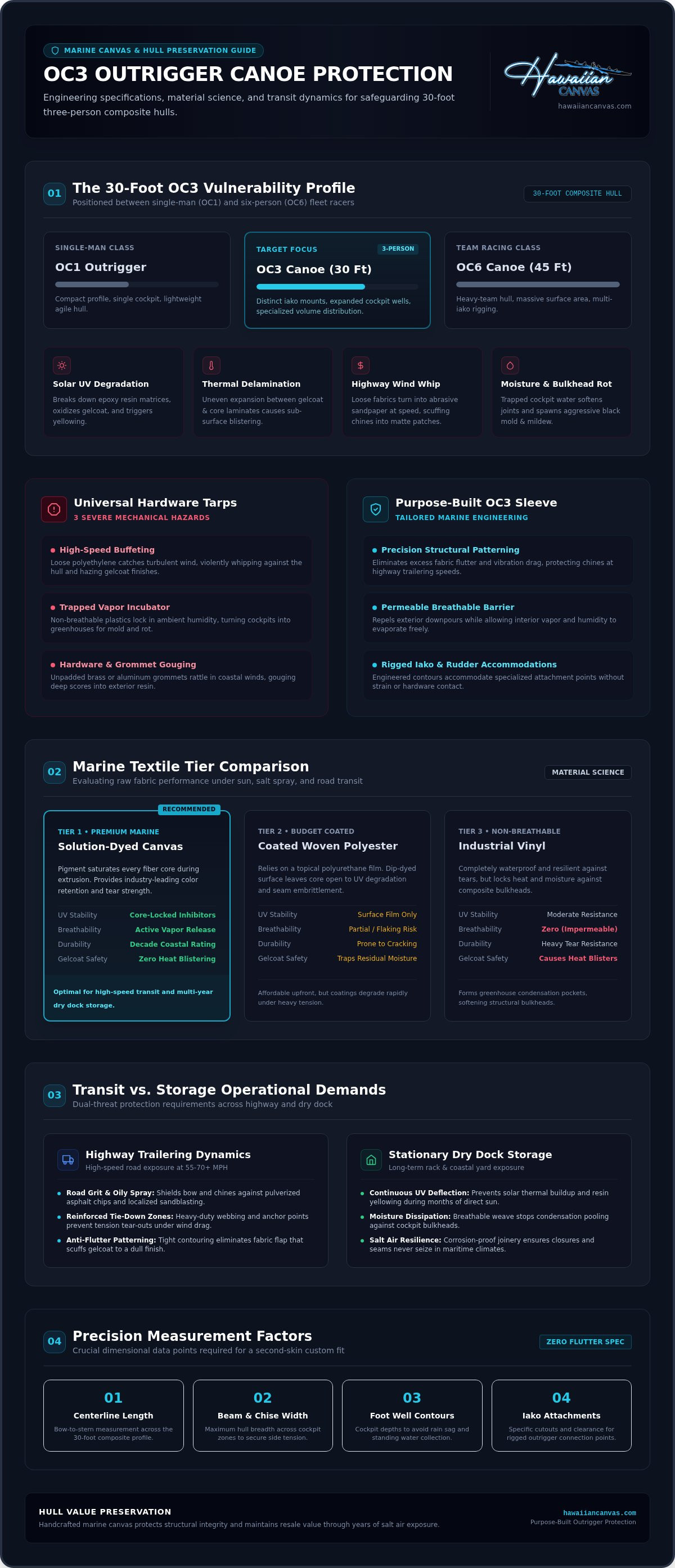
An OC3 canoe cover is a tailored marine sleeve engineered specifically to shield a three-person outrigger hull from environmental fatigue and transit damage. While traditional rowing shells share long profiles, outrigger boats present unique spatial challenges. A thirty-foot OC3 sits squarely between an agile single-man OC1 and a massive forty-five-foot OC6 team racer. It features wider cockpit wells, distinct iako attachment points, and a specialized volume distribution that generic covers simply cannot accommodate.
Leaving an uncovered composite hull in open air triggers rapid deterioration. Solar ultraviolet radiation breaks down epoxy resin matrices, causing gelcoat finishes to oxidize, haze, and lose water resistance. Road transit introduces an entirely different set of threats. High-speed highway towing kicks up pulverized asphalt grit, stone chips, and oily road spray that blast the bow and chines like localized sandblasting.
The Vulnerability of Three-Person Composite Hulls
Intense solar heat concentrates inside dark composite layups. This thermal buildup causes the outer gelcoat and internal structural laminates to expand at uneven rates, eventually resulting in sub-surface blistering and costly delamination. Unfiltered ultraviolet exposure also turns clean white gelcoats yellow and weakens core materials. Inside open cockpits, standing water from unsealed storage collects against bulkheads, softening structural joints and creating an ideal environment for moisture-driven fiberglass rot.
The Limits and Hazards of Universal Boat Tarps
Using a general-purpose plastic tarp is an expensive mistake for any composite watercraft. These makeshift wraps inevitably create severe mechanical wear:
- High-speed buffeting: Loose polyethylene catches turbulent wind behind your vehicle, whipping furiously against the hull and scuffing high-gloss chines into matte patches.
- Trapped vapor: Non-breathable plastics lock in ambient humidity, transforming your cockpits into greenhouse incubators for aggressive mold and black mildew.
- Hardware gouging: Unpadded brass or aluminum grommets rattle against the exterior finish during coastal windstorms, gouging deep scores into the gelcoat.
A precision-patterned OC3 canoe cover replaces loose plastic with snug, heavy-duty marine canvas. This tailored fit eliminates fabric flutter and preserves the vessel's hull integrity over years of road trips and outdoor dry dock storage.
Key Material Specifications for Outrigger Canoe Covers
Protecting an outrigger requires textile engineering capable of withstanding constant exposure. For an OC3 canoe cover, material weight, tensile strength, and permeability dictate whether your craft remains dry dock ready or suffers premature decay. Scientific evaluations on the long-term durability of composite materials demonstrate that unshielded resin systems degrade rapidly under direct solar radiation. The right marine canvas provides an impervious barrier against UV rays while releasing trapped vapor before rot takes root.
Raw materials generally fall into three performance tiers:
- Marine-grade solution-dyed canvas: Pigment saturates every fiber core during extrusion. This ensures industry-leading color retention, extreme tear strength, and genuine breathability that lets interior moisture evaporate freely while repelling downpours.
- Coated woven polyester: Affordable upfront, but relies on a topical polyurethane film. High solar heat and tension cause these surface coatings to crack, flake, and trap trapped moisture against the hull.
- Industrial vinyl: Completely waterproof and resilient against tears, yet entirely non-breathable. Without proper venting, heat blisters form along composite bulkheads within weeks.
Marine-Grade Canvas vs. Standard Polyester Fabrics
Solution-dyed marine fabrics lock ultraviolet inhibitors deep within the yarn structure. In contrast, standard dip-dyed polyesters hold color only on the surface, leaving their synthetic core open to UV degradation and seam embrittlement. If you want a setup that endures season after season of salt spray, reviewing the build standards for custom outrigger canoe covers will help you identify textiles rated for decades under coastal sun.
Hardware Durability: Zippers, Webbing, and Thread
A cover is only as dependable as its joinery. Salt air quickly seizes standard metal hardware, locking closures permanently. Purpose-built covers demand heavy-duty, marine-grade molded polymer zippers with large teeth that actively clear dried salt crystals during closure.
Seams require continuous-filament, UV-stabilized polyester thread. Standard nylon threads dissolve after eighteen months of sun exposure, causing panels to split open at sixty miles per hour. Heavy-duty polypropylene or polyester webbing, backed by reinforced perimeter stitching, ensures high-tension tie-downs remain secure against trailer friction. If you're outfitting your craft for rugged highway travel, exploring handcrafted options from Hawaiian Canvas ensures your hull gets the heavy-duty protection it deserves.
Highway Trailering vs. Stationary Storage: Critical Design Differences
Storage demands and trailering stresses require two very different structural strategies. Stationary rack covers focus on atmospheric runoff and sun blockage. Highway travel bags, however, must conquer intense aerodynamic forces. At sixty-five miles per hour, wind creates negative pressure pockets around an OC3 canoe cover. These low-pressure zones pull slack fabric outward, turning loose material into an abrasive whip that sands your gelcoat while generating massive vehicle drag.
Padding and reinforcement separate an ordinary canvas bag from a true road-ready sleeve:
- Double-layer impact points: Highway transit concentrates brutal vibration where the hull rests against trailer cradles and bunks. High-stress zones require multi-layered canvas backing to cushion friction points during long-distance hauling.
- Internal flap guards: Direct contact between zipper track and gelcoat causes immediate micro-abrasions under road vibration. Heavy canvas protective flaps must isolate coarse zipper teeth completely from the composite surface.
- Form-fitting travel sleeves versus rack blankets: Stationary covers can afford a slightly looser drape for airflow, but highway transport mandates a contour-locked profile that cuts through clean air without fluttering.
Engineering Covers for High-Speed Highway Travel
Aerodynamic stability requires a precision fit along all thirty feet of the hull. Heavy-duty cinch straps spaced along the midsection compress the fabric tight against the cockpit curves, preventing highway drafts from ballooning the sleeve. Up front, reinforced bow and stern caps shield fragile ends from gravel thrown by passing trucks. The resulting streamlined profile reduces wind resistance and stops fabric movement before friction damages the finish.
Ventilation and Weather Defense for Outdoor Rack Storage
Paddlers know that keeping equipment properly stored and covered is a mandatory stewardship rule at reputable canoe clubs. Out in the yard, rain pooling poses the greatest immediate threat. Spanning three large cockpit bays, a thirty-foot hull can quickly trap gallons of rainwater if the fabric sags, stretching the seams and crushing internal cockpit ribs under heavy water weight.
Effective stationary protection integrates arched canvas tensioning that sheds torrential rain off the gunwales instantly. Integrated ventilation ports allow passive air movement through the interior chamber, bleeding off concentrated heat on ninety-degree summer days. This constant circulation stops humidity from settling against gelcoat seams while locking out falling leaves, acidic bird droppings, and gritty airborne dirt.
How to Measure Your OC3 Canoe for a Precision Fit
A thirty-foot canoe leaves zero room for guesswork. A sloppy measurement results in excess canvas that whips on the road or a sleeve so tight you risk breaking zippers over gunwales. Hull geometries also shift dramatically between flatwater sprint designs, open-ocean hulls with deep rocker, and sailing configurations featuring reinforced mast steps. Capturing true proportions guarantees your OC3 canoe cover fits like an intentional skin.
Steering setups and hardware create clearance requirements as well. Permanently glassed wae blocks, rigging eyelets, foot-pedal steering cables, and rudder housings protrude beyond basic hull outlines. Taking accurate field measurements ensures internal relief pockets sit directly over rigid hardware without tension.
Step-by-Step Hull Dimension Checklist
Grab a fiberglass tape measure, avoid pulling along curving gunwales, and document these four critical lines:
- Centerline length: Run a taught straight line from the front tip of the manu ihu (bow) straight back to the stern blade.
- Cockpit station beams: Measure the exterior gunwale width at each individual seat station, as beam tapers significantly between the middle paddler and the ends.
- Keel-to-sheer vertical depth: Measure vertical hull height from the deepest point of the keel up to the sheer line at each seat station.
- Wae block spacing: Record the exact distance from the bow tip to the forward wae, and note the centerline gap between the front and rear iako mounts.
Protecting the Full Rig: Amas, Iakos, and Rudders
Protecting the main hull is only part of outfitting an outrigger. Amas and iakos take tremendous punishment on roof racks and trailer bunks. Reviewing technical specs for ama covers for outrigger craft shows why form-fit foam sleeves prevent pressure dents across delicate foam cores.
Bare aluminum or laminated wood iakos vibrate against metal rack bars during road transit, causing deep gouges. Heavy-duty padded iako sleeves prevent finish wear and keep salt film off rigging surfaces. At the stern, specialized rudder caps cushion thin composite fins from low-speed backing bumps, parking lot mishaps, and gravel strikes. When you're ready to protect your entire rig with precision patterning, order custom canoe canvas from Hawaiian Canvas to safeguard every inch of your watercraft.
Selecting Handcrafted Outrigger Canvas Built for Lifelong Durability
High-end composite canoes represent a major financial investment. Treating their protective gear as an afterthought risks expensive gelcoat repairs and structural fatigue down the line. A handcrafted OC3 canoe cover serves as vital hull insurance. Unlike mass-produced imported covers cut from generic recreational boat patterns, artisan-stitched canvas is tailored around the exact stresses of maritime transport. Precision flat-felled seams, reinforced bar-tacking at pressure points, and marine-grade thread ensure your sleeve resists splitting under severe coastal winds and salt exposure.
Custom outrigger shops also build to accommodate specific boat modifications. Whether your OC3 features custom sailing conversion bulkheads, raised spray coamings, or modified foot-steering systems, dedicated craftspeople incorporate targeted cutouts and relief panels that mass manufacturers routinely overlook.
The Value of Paddler-Crafted Marine Gear
There is no substitute for real water time. Covers built by active ocean paddlers reflect an intimate understanding of rough launch ramps, heavy shorebreak, and rugged beach setups. High-wear zones, such as the contact points around gunwales and trailer supports, receive reinforced structural backing developed directly from years of shoreline experience. Managing multiple canoes across a club or private fleet demands this level of reliability, a principle discussed in our guide to OC6 canoe storage covers for large-scale boat protection.
Caring for Marine Canvas to Maximize Lifespan
Even the toughest marine-grade textiles require straightforward maintenance to preserve their strength. Salt crystals act like microscopic razor blades against stitching if allowed to dry in place. Developing simple maintenance habits protects your gear across many paddling seasons:
- Rinse after every salt exposure: Spray down the entire cover and flush zipper tracks with fresh, clean water after coastal trips to clear out dried salt deposits.
- Dry fully before storage: Never pack away wet or damp canvas into a confined space. Allow the fabric to air dry completely to prevent trapped moisture and mildew.
- Refresh water repellency: Apply a specialized marine-grade fabric guard every two to three seasons to restore surface water beading and reinforce ultraviolet barriers.
Treating your canvas with regular care keeps the material pliable and water-resistant. A properly maintained cover preserves your canoe's sleek finish, maintains resale value, and ensures your three-person outrigger remains ready for open water year after year.
Protect Your Hull for Years of Open Ocean Paddling
A thirty-foot outrigger canoe is built for ocean performance, not for enduring relentless UV baking or abrasive highway friction. Shielding your composite craft with a dedicated OC3 canoe cover prevents premature gelcoat oxidation, eliminates destructive fabric flutter at highway speeds, and safeguards fragile ends from flying road debris.
Off-the-shelf boat tarps simply can't accommodate unique outrigger cockpits or specialized rigging points. Your hull demands marine canvas engineered to handle salt air and trailer vibration without compromise. Handcrafted in Hawaii by seasoned paddlers using ocean-tested techniques, our gear pairs heavy-duty UV-resistant fabrics with patterns tailored precisely to three-person outrigger geometries. Shield your three-person outrigger with handcrafted marine canvas from Hawaiian Canvas and ensure your craft stays race-ready for every ocean crossing ahead.
Frequently Asked Questions
Can I use an OC6 canoe cover or an OC2 cover for an OC3 canoe?
No, you cannot properly protect an OC3 using OC2 or OC6 covers. An OC2 cover is roughly twenty-two feet long and will not stretch over a thirty-foot hull. Conversely, an OC6 cover leaves fifteen feet of flapping canvas that causes severe highway drag and pooling. Outrigger canoes require exact cockpit placement and wae spacing. A dedicated OC3 canoe cover provides the snug, contour-locked profile needed to prevent chafing and wind damage.
What is the difference between a storage cover and a trailering cover for an OC3?
Storage covers prioritize ventilation and sun protection to prevent heat buildup and internal condensation during long-term yard resting. Trailering covers, by contrast, focus on aerodynamic tension and mechanical strength. They feature reinforced bow caps, multi-layer trailer bunk padding, and heavy-duty compression straps that eliminate high-speed flutter. While a rugged trailering cover easily doubles for stationary storage, loose storage tarps will tear and scuff gelcoats under highway wind pressure.
How do I protect my OC3 canoe cover zippers from seizing in saltwater environments?
Rinse your zipper tracks thoroughly with fresh water after every ocean outing. Salt crystals dry and harden inside the slider mechanism, causing metal or polymer teeth to bind. Lubricate the tracks periodically using a clear, silicone-free marine zipper wax or dry PTFE lubricant. Avoid petroleum-based greases, which attract beach sand and grit. Regular rinsing ensures smooth glide action and extends the working life of heavy-duty marine hardware.
Does a custom OC3 canoe cover accommodate canoes rigged with sailing hardware?
Yes, a custom OC3 canoe cover can be tailored around specialized sailing gear. Standard paddling cuts won't clear raised mast steps, heavy stays, or exterior sheet hardware. When commissioning a custom canvas, provide specific measurements and positions for mast blocks, rudder gudgeons, and daggerboard trunk housings. Craftsmen then integrate reinforced cutouts, gussets, and storm flaps to keep the entire sailing hull sealed against weather.
Can a fitted OC3 canoe cover be installed by one person?
Yes, one person can install a tailored thirty-foot cover with the right technique. Start by hooking the reinforced bow pocket over the nose of the canoe. Walk the canvas down the length of the hull, pulling the gunwales into place as you move toward the stern. Once the stern cap is positioned, fasten the belly cinch straps and zip the main closures. Precision patterning keeps the fabric aligned without fighting excess slack.
How long does a heavy-duty marine canvas canoe cover typically last outdoors?
A heavy-duty, solution-dyed marine canvas cover typically lasts between seven and ten years in continuous outdoor exposure. Because the pigment and UV inhibitors saturate the yarn core rather than just coating the exterior, the fabric resists fading and solar degradation far longer than standard polyester. Routine maintenance, such as rinsing off salt film and reapplying a fluoropolymer water repellent every few seasons, maximizes fabric resilience against harsh coastal sun.
What should I do if water pools in the cockpit area during heavy rain?
Inspect your tie-down tension immediately. Water collects when canvas sags between cockpit gunwales, creating heavy basins that stress seams. Tighten belly straps to restore an arched crown across the cockpits, allowing rain to roll off the sides. For flat yard racks, place an inexpensive foam noodle or soft cockpit batten beneath the canvas to maintain positive runoff pitch. Never let stagnant pools sit, as heavy water weight distorts composite hull shapes.