

OC6 Canoe Storage Covers: The Complete Fleet Protection Guide
Your OC6 fleet is likely your club's largest capital investment, yet it spends most of its life being slowly destroyed by the very environment it was built for. Constant exposure to intense UV rays and salt air doesn't just dull the finish; it compromises the structural integrity of the composite. You've likely seen the results: chalky gelcoat oxidation, seized rigging, and the persistent threat of mold trapped under poorly fitting tarps. It's a frustrating cycle of maintenance that eats into your time on the water.
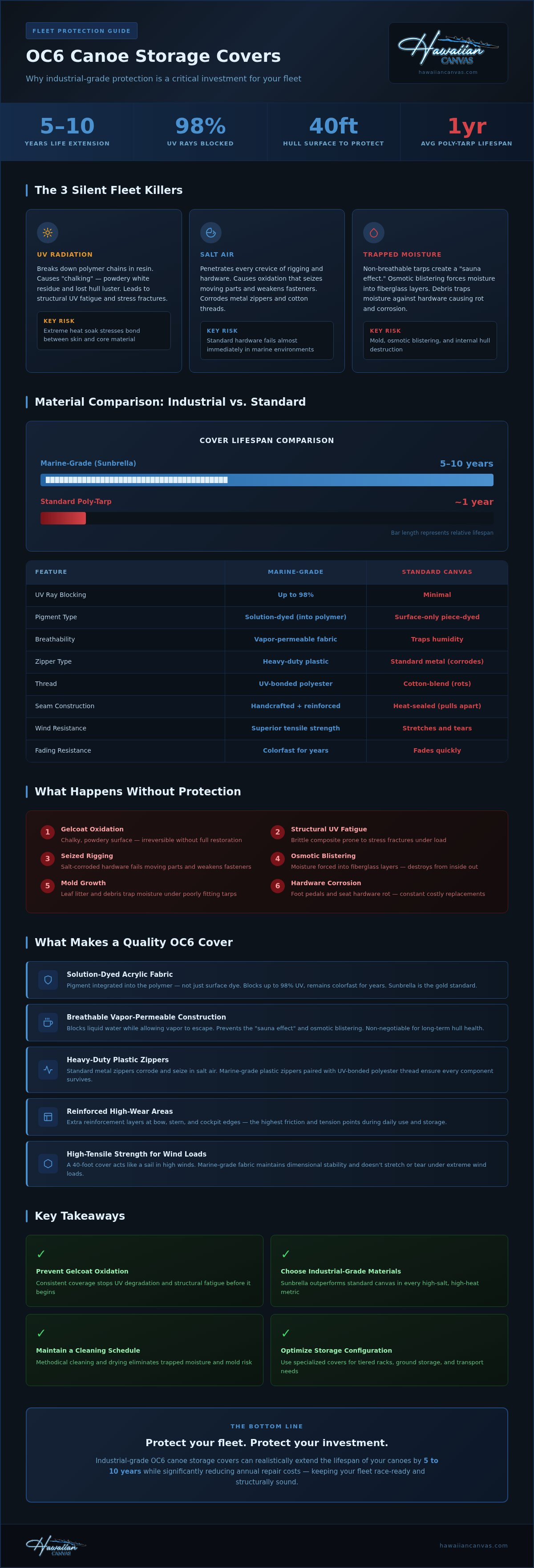
Investing in industrial-grade OC6 canoe storage covers is a strategic move to protect these essential assets. These solutions are designed to withstand the harshest marine conditions while allowing the hull to breathe. By choosing the right protection, you can realistically extend the lifespan of your canoes by five to ten years and significantly reduce annual repair costs. This guide explores how to select the right materials and fit to ensure your fleet remains racing-ready and structurally sound for years to come.
Key Takeaways
- Protect your club's capital investment by preventing gelcoat oxidation and structural UV fatigue through consistent coverage.
- Identify why industrial-grade materials like Sunbrella outperform standard canvas in high-salt, high-heat environments.
- Optimize your storage layout with specialized OC6 canoe storage covers designed for tiered racks and ground protection.
- Implement a methodical cleaning and drying schedule to eliminate the risk of trapped moisture and mold.
- Extend the operational life of your fleet by up to a decade by choosing gear built for real-world ocean conditions.
Why OC6 Canoe Storage Covers are a Critical Investment
Every OC6 in your yard represents a significant capital investment for your club or team. Leaving these hulls exposed to the elements is a slow financial leak. High-quality OC6 canoe storage covers aren't optional accessories; they are essential defensive gear. Without them, the sun and salt work around the clock to degrade the hull finish and the structural core. A protected fleet ensures that your resources are spent on racing and training rather than avoidable restoration projects.
Understanding UV Degradation on Large Hulls
Solar radiation is the primary enemy of composite materials. UV rays penetrate the gelcoat and begin breaking down the polymer chains in the resin. This process, known as photo-degradation, manifests first as "chalking," where the hull loses its luster and develops a powdery white residue. On a 40-foot hull, the surface area exposed to the sun is massive. This constant exposure leads to structural UV fatigue, making the canoe more brittle and prone to stress fractures during heavy water sessions.
Uncovered hulls also suffer from extreme heat soak. On a cloudless day, internal temperatures can spike, stressing the bond between the skin and the core material. Protecting the cockpit and internal rigging is just as vital. Environmental debris like leaf litter and bird droppings can trap moisture against the foot pedals and seats, leading to rot or hardware corrosion. A well-fitted cover seals out these contaminants while maintaining the canoe's race-ready condition.
Moisture and Salt: The Silent Fleet Killers
Salt air is a constant threat in marine environments. It finds its way into every crevice of the rigging and hardware, causing oxidation that can seize moving parts and weaken fasteners. While protection is necessary, the cover must also breathe. Poorly designed tarps trap humidity, which can lead to osmotic blistering where moisture is forced into the fiberglass layers. This creates a "sauna effect" that destroys hulls from the inside out.
Professional OC6 canoe storage covers utilize specialized fabrics that block liquid water while allowing vapor to escape. This breathability is non-negotiable for long-term health. Beyond the technical benefits, a covered fleet sends a clear message. It signals a club that respects its equipment and its traditions. A disciplined approach to storage ensures that when race day arrives, your fleet is clean, dry, and structurally sound. This level of care reflects a professional standard that members and sponsors notice.
Marine-Grade Materials: Sunbrella vs. Standard Canvas
Not all fabrics are created equal. In the harsh environment of a canoe yard, standard canvas or cheap poly-covers are a liability. They lack the technical properties to withstand constant UV bombardment and salt spray. For long-term protection, OC6 canoe storage covers must be constructed from industrial-grade marine fabrics. These materials are engineered for durability and dimensional stability under extreme stress.
The Superiority of UV-Resistant Marine Fabrics
Pigment matters. Standard fabrics are often piece-dyed, meaning the color only sits on the surface. Solution-dyed acrylics, like Sunbrella, incorporate the pigment directly into the polymer during the manufacturing process. This creates a colorfast barrier that resists fading and degradation for years. High-quality marine fabrics block up to 98% of harmful UV rays. This level of protection extends the life of your cover to five or ten years, compared to the one-year lifespan of a basic poly-tarp. For more detailed insights, read The Ultimate Guide to Custom Outrigger Canoe Covers in 2026.
Wind is a constant factor. A 40-foot canoe cover has a massive surface area that acts like a sail. Marine-grade fabrics offer superior tensile strength, ensuring the material doesn't stretch or tear under high-wind loads. Saltwater resistance is equally critical. Standard metal zippers and cotton-blend threads fail almost immediately in marine air. They corrode or rot, rendering the cover useless. We use heavy-duty plastic zippers and UV-bonded polyester thread to ensure every component survives the salt, making high-quality OC6 canoe storage covers a necessity for coastal clubs.
Reinforcement and Stitching for Longevity
Seams are the weakest point of any cover. Mass-produced items often rely on heat-sealed seams that can pull apart under stress or high temperatures. We prioritize handcrafted precision. UV-bonded polyester thread is essential because it won't break down when exposed to the sun. We also add extra layers of reinforcement to high-wear areas like the bow, stern, and cockpit edges. These are the points where the cover experiences the most friction and tension during daily use. Investing in marine-grade protection ensures your fleet stays race-ready regardless of the weather.
Storage Configurations: Racks, Ground, and Transport
Every club manages its fleet differently based on available space and local geography. A 45-foot hull presents unique logistical hurdles whether it's sitting on a tiered rack or resting on the sand. Effective OC6 canoe storage covers must adapt to these specific environments without compromising protection. The way you secure your gear determines how well it survives high winds and prevents internal moisture buildup.
Rack Storage Challenges
Most clubs utilize vertical racks to maximize space. Installing a heavy cover on a canoe stored six feet off the ground is a safety risk and a physical chore. Our designs prioritize ease of use with lightweight, high-strength materials that don't fight the user. When canoes are stored on racks, you also have to manage the 'iako and ama. While the main hull is protected, these components remain exposed unless you use specialized accessories like Iako Sleeves or Ama Covers. This creates a complete barrier against the elements.
Drainage is another critical factor for rack storage. Whether your club stores canoes hull-up or hull-down, the cover must allow water to shed rather than pool. Pooled water adds thousands of pounds of stress to the rack and the hull. We ensure our patterns account for these angles, preventing the fabric from sagging and creating water pockets. This keeps the fleet light and the equipment safe from structural strain.
Ground storage introduces different threats. Storing a canoe directly on the grass or sand invites moisture wicking and pest infestations. Rodents and insects often seek shelter inside uncovered cockpits, leading to damaged seats and fouled rigging. A full-length cover acts as a sealed deterrent. It's essential to ensure the cover doesn't touch the damp ground, as this can draw moisture up against the gelcoat. Proper tensioning keeps the fabric crisp and the hull dry.
Preparing for Long-Distance Transport
While storage covers are primarily for stationary protection, they often pull double duty for local transport. Highway speeds create immense pressure. A cover that fits loosely will flap violently, causing "flap wear" that can scuff the canoe's finish and shred the fabric seams. For any movement, OC6 canoe storage covers require a robust strap system rather than simple drawstrings. Straps allow you to cinch the material tight against the hull, eliminating vibration.
Efficiency matters during club loading days. We incorporate quick-access features that allow teams to secure their fleet fast. This reduces the time spent in the parking lot and increases time on the water. By using a cover designed for both storage and light-duty travel, you simplify your gear list while maintaining a high standard of protection for your most valuable assets.
How to Maintain Your OC6 Cover Fleet
Proper maintenance isn't just about the canoe; it's about the gear that protects it. Even the highest-quality OC6 canoe storage covers require a disciplined routine to perform at their peak over several seasons. Neglecting the fabric allows salt to crystallize within the weave. These crystals act like sandpaper, grinding down the fibers every time the wind moves the material. A seasonal schedule ensures your fleet remains protected without the risk of premature material failure.
Cleaning and Salt Removal
Marine environments are relentless. Salt air and industrial pollutants build up on the surface of the canvas, attracting moisture and promoting mold growth. Follow these steps to preserve the integrity of your equipment:
- Rinse with fresh water: Perform a thorough rinse after every ocean exposure. This simple step removes surface salt and grime before they can penetrate the fabric.
- Use specialized cleaners: Avoid generic household detergents. Harsh soaps strip the water-repellent and UV-resistant coatings from marine-grade fabrics. Use only cleaners specifically formulated for solution-dyed acrylics to maintain the material's technical properties.
- Air dry completely: Never fold or store a damp cover. Trapped moisture is the primary cause of mildew and foul odors in club storage areas. Ensure the fabric is bone-dry before it's packed away.
Repair and Reinforcement
Inspect your covers monthly for "hot spots." These are specific areas where the rack arms, trailer supports, or hull hardware create constant friction against the fabric. Identifying these points early allows for preventative patching before a small scuff becomes a structural tear. High-stress seams should be checked for loose threads or tension gaps. While UV-bonded polyester thread is exceptionally durable, the physical abrasion from a 40-foot hull can eventually wear through even the strongest reinforcement.
Knowing when to replace a cover is a matter of fleet safety. If the fabric becomes brittle or shows visible thinning where light passes through easily, the UV barrier is compromised. At this stage, the cover is no longer protecting the canoe's gelcoat from structural fatigue. Keeping your gear in top condition is easier when you start with handcrafted OC6 canoe storage covers built specifically for these harsh conditions.
When the fleet is on the water, store the covers in a clean, dry location. Don't leave them in a heap on the sand or on a damp dock. UV exposure continues even when the cover isn't on the boat, so keeping them in a shaded bin or locker preserves the material's lifespan. A well-managed cover fleet is the backbone of a professional club's equipment strategy.
The Hawaiian Canvas Standard: Handcrafted Excellence
We don't just manufacture gear; we live the lifestyle. Our team understands that outrigger canoes are more than equipment. They are cultural vessels and high-performance racing machines. This perspective shapes every stitch of our OC6 canoe storage covers. We build our products to withstand the same conditions we face on the water. This isn't mass-market manufacturing. It's a specialized craft focused on doing one thing exceptionally well. Handcrafted by experienced artisans, our gear is born from the realities of intense salt and sun.
Rugged dependability is our benchmark. Every piece of canvas that leaves our shop undergoes rigorous quality control. We don't outsource our production to detached corporations. By keeping our manufacturing in-house, we maintain absolute precision over every seam and reinforcement. This artisanal approach ensures that your fleet receives industrial-grade protection that mass-produced alternatives simply cannot match. We prioritize utility and performance over market trends, focusing on the physical properties that matter most: durability, weight, and wear resistance.
Custom Patterns for Specific Models
A loose cover is a failing cover. Generic, universal fits create pockets where water pools and wind catches. These "sails" put unnecessary strain on your rack and your hull. We use precision patterns tailored to specific OC6 racing models. This ensures a fit that mirrors the lines of the canoe. Our designs accommodate racing-specific features and spray skirt attachments without compromise. A cover that fits like a second skin provides the ultimate defense against structural UV fatigue and environmental debris. It's a technical barrier designed for a precise fit.
Supporting the Global Outrigger Community
Protection should be comprehensive. A covered hull is only part of the equation. We provide a full suite of marine-grade solutions, including Ama covers, Iako sleeves, and Rudder caps. This ensures every component of your fleet is shielded from the elements. We ship our handcrafted gear worldwide, supporting paddlers and clubs from the Pacific to the Atlantic. Our commitment to heavy-duty protection remains the same regardless of your location. We're fellow practitioners who understand your challenges. Protect your fleet with handcrafted OC6 covers and ensure your canoes are racing-ready for every season.
Building a Resilient Fleet Strategy
Your OC6 fleet represents the heart of your club's competitive potential. Protecting these vessels requires more than a casual approach to storage. By prioritizing marine-grade materials and establishing a disciplined maintenance routine, you shift from reactive repairs to proactive fleet management. The right OC6 canoe storage covers provide a technical barrier that preserves gelcoat integrity and prevents structural fatigue. This investment ensures your canoes remain racing-ready for years to come.
Our gear is handcrafted in Hawaii for real ocean conditions. We utilize heavy-duty UV and salt-resistant construction to meet the harsh demands of the natural environment. It's the reason elite outrigger clubs nationwide trust our craftsmanship to safeguard their most valuable assets. Don't let the sun and salt compromise your equipment's structural integrity. You've worked hard to build your fleet. We work hard to keep it protected.
Secure your OC6 fleet with heavy-duty storage covers from Hawaiian Canvas. Respect the craft. Protect your investment. Keep your focus on the water.
Frequently Asked Questions
Do I need a separate cover for the ama and iakos when storing an OC6?
Yes. While the main hull cover protects the largest component, the iakos and amas are equally vulnerable to UV fatigue and salt corrosion. We recommend using specialized Iako Sleeves and Ama Covers to ensure the entire rig is shielded. This prevents uneven weathering and keeps your hardware from seizing. A complete protection strategy is the only way to ensure the fleet remains racing-ready and structurally sound across all components.
How long should a high-quality OC6 storage cover last in high-UV areas?
A high-quality cover constructed from marine-grade materials typically lasts five to ten years. In regions with extreme UV exposure, you can expect reliable performance for at least five years before the fabric shows signs of thinning. Standard poly-tarps often degrade within a single season. Investing in industrial-grade OC6 canoe storage covers ensures your fleet stays protected through years of intense solar bombardment without the risk of material failure or UV penetration.
Can I use a storage cover while transporting my OC6 on a trailer?
You can use these covers for local transport, but highway speeds require extra caution. Storage covers are designed for stationary protection, and the wind pressure at 60 mph can cause loose fabric to flap violently. This "flap wear" scuffs your gelcoat and stresses the seams. If you must use a storage cover on a trailer, use additional heavy-duty cinch straps to secure the fabric tight against the hull and eliminate any vibration.
Is it better to store an OC6 hull-up or hull-down when using a cover?
Storing your OC6 hull-up is the most effective configuration for drainage. This position allows rainwater to shed naturally off the cover, preventing the material from sagging or pooling. If your club's rack requires hull-down storage, you must tension the cover perfectly to avoid "bird baths." Pooled water creates thousands of pounds of pressure that can damage both the cover and the canoe's internal structure. Effective water runoff is critical for longevity.
How do I prevent mold and mildew from growing under my canoe cover?
Prevention starts with breathability and airflow. Never install a cover on a wet hull or store a damp cover in a bin. Our specialized fabrics are designed to block liquid water while allowing internal moisture vapor to escape. If you store your canoes in high-humidity areas, ensure the fleet is bone-dry before covering. Establishing a seasonal cleaning schedule with marine-safe cleaners also removes the organic debris that mold and mildew need to grow.
Are Sunbrella covers worth the extra cost for a canoe club?
For any serious club, the answer is yes. Solution-dyed acrylics like Sunbrella provide 98% UV protection and maintain their tensile strength for nearly a decade. Cheap canvas or poly-covers often fail within twelve months, leaving your hulls exposed. When you calculate the cost over five years, high-performance OC6 canoe storage covers are actually the more economical choice. They reduce the frequency of replacements and provide superior defense against gelcoat oxidation and structural fatigue.
What is the best way to secure an OC6 cover against high winds?
The best method is a combination of a precision fit and a robust strap system. A cover that follows the hull's lines leaves less material for the wind to catch. Heavy-duty buckles and straps allow you to cinch the cover tight, preventing it from "parachuting" or shifting during storms. Avoid relying solely on drawstrings, as they can loosen or fray. Keeping the fabric taut against the hull is the most effective defense against wind-driven damage.