

Surf Ski Travel Covers: The 2026 Guide to Long-Distance Transport Protection
A storage sock is not a travel cover, and mistaking the two at highway speeds can destroy your gelcoat before you even reach the launch. When you're hauling a twenty-foot craft at 70 mph, the wind doesn't just blow; it claws at your gear. Whether we are handcrafting heavy-duty six-man canoe covers or specialized surf ski protection, the engineering requirements remain the same. You need a shield that stays silent and stationary. Most paddlers agree that the sound of flapping fabric is the sound of your investment losing value.
We promise to break down the specific materials and design features that prevent wind-flap abrasion and sun rot during cross-country drives. You'll learn how to identify marine-grade fabrics like Sunbrella that offer maximum UV resistance without unnecessary bulk. We will also examine how a custom fit allows for easy, solo installation so you can spend more time on the water and less time fighting with straps. This 2026 guide previews the latest standards in transport protection, ensuring your ski arrives in the same condition it left the rack.
Key Takeaways
- Understand the 'Highway Factor' and how 70 mph winds turn loose storage socks into abrasive sandpaper against your gelcoat.
- Compare the technical superiority of Sunbrella fabric and marine-grade thread to ensure maximum UV protection during long-haul drives.
- Explore how the precision patterning used for six-man canoe covers eliminates the 'Parachute Effect' and reduces vehicle drag.
- Master the essential preparation steps, including hull cleaning and the use of rudder caps, to prevent scratches and mechanical damage.
- Discover why handcrafted Hawaiian engineering provides a level of resilience that mass-produced universal covers cannot match.
The Risks of Long-Distance Transport: Why Your Surf Ski Needs More Than a Sock
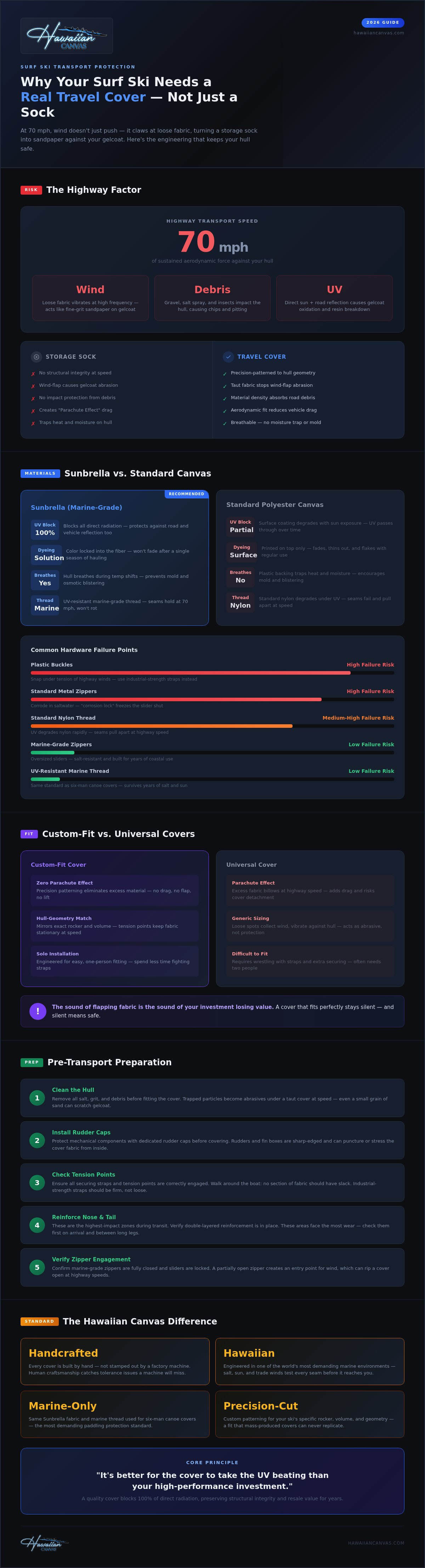
Transporting a surf ski at highway speeds is a different beast than keeping it in the garage. While a simple stretch sock might keep dust off a hull in a shed, it offers zero defense against the mechanical forces of a long-haul drive. We call this the "Highway Factor." At 70 mph, wind pressure doesn't just push against your boat; it searches for any loose fabric to exploit. Much like the heavy-duty engineering required for six-man canoe covers, surf ski protection must be built to withstand sustained aerodynamic stress. If the fabric isn't anchored correctly, it becomes a liability rather than an asset.
Road debris presents a constant threat during transit. Your vehicle tires kick up gravel, salt spray, and insects that strike your gelcoat with significant force. Without a dedicated travel cover, these impacts cause immediate stone chips and pitting. A thin sock lacks the material density to absorb these strikes. You need impact protection, not just a dust barrier. A proper cover creates a physical buffer that preserves the smooth, high-performance finish of your craft, ensuring it remains as fast as the day it was built.
Wind-Flap and Gelcoat Abrasion
Loose fabric is the enemy of a pristine finish. When a cover isn't patterned to the specific rocker and volume of your ski, the excess material creates high-frequency micro-vibrations. At highway speeds, this wind-flap acts like fine-grit sandpaper, dulling the gelcoat and leaving permanent hazy patches. Our design philosophy prioritizes tension points that keep the fabric taut. Stretch-socks are unsuitable for this environment because they lack the structural integrity to stay still. They move, they vibrate, and they eventually abrade the very surface they're meant to protect. Reliable protection requires a fit that mirrors the hull's geometry.
UV Exposure During Transport
Roof-rack travel exposes your boat to the most intense UV environment possible. You aren't just dealing with direct sunlight; you're dealing with reflection from the road surface and the vehicle itself. Hours of exposure lead to gelcoat oxidation and the chemical breakdown of resins, making the hull brittle over time. Just as we use marine-grade materials for our six-man canoe covers, we build surf ski covers to act as a sacrificial layer. It's better for the cover to take the UV beating than your high-performance investment. A quality cover blocks 100% of direct radiation, preserving the structural integrity and resale value of your craft for years to come.
Marine-Grade Materials: Sunbrella vs. Standard Canvas for Travel
The choice of material determines whether your cover is a protective shield or a liability. Many generic "marine" covers use polyester with a plastic backing. This traps heat and moisture against your hull. Industrial-grade Sunbrella operates on a different principle. It balances water resistance with high breathability. This prevents the mold growth and osmotic blistering that occurs when moisture is locked under a hot cover on a roof rack. Resilience starts at the molecular level.
Thread is the silent failure point in most travel gear. Standard nylon thread degrades quickly under UV exposure. Once the thread rots, the seams pull apart at 70 mph. We use UV-resistant marine-grade thread in every stitch. This is the same standard we apply to our six-man canoe covers to ensure they survive years of salt and sun. If the stitching fails, the most expensive fabric in the world won't protect your boat.
The Sunbrella Advantage for Surf Skis
Sunbrella fabric is solution-dyed. The color is locked into the fiber itself, not just printed on the surface. This ensures your gear won't fade or thin out after a single season of long-distance hauling. Breathability remains its most critical feature for paddlers. It allows the hull to "breathe" during temperature shifts, protecting the expensive resins in your ski. Sunbrella's solution-dyed acrylic composition remains the gold standard for marine protection in 2026.
Hardware and Reinforcement
Travel covers face high-impact stress at the nose and tail. Just as with six-man canoe covers, these are high-impact zones that demand double-layering. We reinforce these sections to prevent the hull from wearing through the fabric during transport. Hardware choice is equally vital. Plastic buckles often snap under the tension of highway winds. We utilize industrial-strength straps that distribute pressure evenly across the hull.
Zippers represent another common failure point. Standard metal zippers corrode in saltwater environments, leading to "corrosion lock" where the slider refuses to move. Marine-grade zippers with oversized teeth are necessary for long-term reliability. Regular freshwater rinses keep these components functional. When you invest in OC1, OC2, and Surf Ski covers, you are paying for hardware that won't leave you stranded at the trailhead. Precision engineering ensures every strap and zipper performs when the conditions get rough.
Custom-Fit vs. Universal Covers: Comparing Aerodynamics
Universal covers are essentially oversized bags. They don't account for the aggressive rocker or the narrow beam of a performance ski. This lack of precision creates the "Parachute Effect." When air enters the gaps at the nose or tail, it inflates the cover and increases aerodynamic drag. This isn't just a matter of fuel economy; it's a matter of safety. High-pressure air pockets pull against your roof rack straps, creating unnecessary stress on your tie-down points. Much like the design process for custom outrigger canoe covers, travel protection for surf skis requires a skin-tight fit to remain stable at 70 mph.
Precision patterning ensures the fabric follows the unique geometry of your craft. A custom cover eliminates the excess material that usually bunches up near the cockpit or the tail. The engineering required for a twenty-foot surf ski is as demanding as the patterns we develop for six-man canoe covers. When the cover mirrors the hull, the wind flows over the surface rather than catching under it. This streamlined profile is the only way to ensure your boat doesn't shift or vibrate during a cross-country haul.
Aerodynamic Performance on the Road
Stability is the primary benefit of a custom fit. A snug cover prevents the boat from sliding within the fabric, which is a common cause of gelcoat scuffing. It also eliminates the loud "drumming" sound caused by flapping material. This noise is more than an annoyance; it's the sound of energy being wasted and fabric being stressed. A streamlined transport profile reduces wind resistance, which leads to noticeable fuel efficiency benefits over long distances. Your vehicle works less, and your gear stays silent.
The Comparison: Custom vs. Universal
Choosing between a universal and a custom option often comes down to the frequency of travel. For those who only move their boat once a year, a "one size fits all" bag might seem sufficient. However, for active paddlers, the long-term value of a custom investment is clear. Universal covers usually mean "one size fits none" for performance skis. They lack the reinforced access points needed to pass straps directly over the hull, which is essential for a secure mount.
| Feature | Custom-Fit Cover | Universal Cover |
|---|---|---|
| Fit | Snug; follows hull rocker | Loose; bulky pockets |
| Longevity | 5-10+ years | 1-2 seasons |
| Wind Noise | Silent | Loud 'Drumming' |
| Strapping | Integrated access points | Straps go over fabric |
Investing in a custom cover built with the same precision as six-man canoe covers ensures your ski is protected by engineering, not just luck. It's the difference between a secure transport and a stressful drive.
Preparation Guide: Securing Your Surf Ski for the Long Haul
Preparation is as critical as the gear itself. You wouldn't launch a boat with a loose bung, and you shouldn't hit the highway without a systematic check of your setup. The first step is a thorough cleaning. Any salt or road grime left on the hull acts as an abrasive once the cover is on. Even with a precision fit, the slight movement of travel turns trapped grit into sandpaper. This is a common oversight when paddlers transition from using static surf ski storage covers to dynamic travel protection. A clean hull ensures the fabric sits flush against the gelcoat without causing micro-scratches.
Protecting the steering assembly is equally vital. The rudder is a precision instrument and a high-impact point during transit. Road debris or a sudden shift in the rack can bend the blade or stress the housing. Using specialized rudder caps provides a cushioned barrier that prevents mechanical damage. It's a small investment that prevents a major repair before your next race. This level of detail is a standard we maintain for our heavy-duty six-man canoe covers; every component of the craft deserves dedicated protection from the elements.
Strap management requires a balanced touch. Over-tightening is a common mistake that can lead to structural damage. Modern composite skis are built for speed, not crushing force. You want the boat secured, but you don't want to compromise the integrity of the hull. Distribute the load evenly across the contact points. Much like the tensioning required for six-man canoe covers, the goal is a firm hold that doesn't deform the shape of the craft. Proper strap placement ensures the boat stays put without the risk of a cracked seam.
Pre-Travel Inspection Checklist
A methodical approach prevents roadside emergencies. Start by ensuring the cockpit is completely dry. Trapped moisture leads to humidity buildup and can affect the finish under high temperatures. Secure all internal bungees and lines; any loose item inside the cockpit will rattle and potentially damage the interior during a ten-hour drive. Verify that the rudder is locked in a neutral position to prevent it from swinging against the cover fabric. A quick final walk-around ensures your professional rudder caps and covers are seated correctly before you pull out of the driveway.
Roof Rack Best Practices
The interface between your car and your boat is where most failures occur. Always use foam padding or specialized cradles to support the hull's curve. A flat rack on a curved boat creates dangerous pressure points. When securing your cam straps, add a single twist to the webbing. This breaks the airflow and eliminates that high-pitched wind whistle that plagues long drives. After the first 50 miles, pull over. Straps often settle as the boat finds its seat, and a quick tension check ensures everything remains rock-solid for the remainder of the journey.
The Hawaiian Canvas Standard: Handcrafted Travel Protection
We don't build for the average. We build for the extreme. Our protection standards are rooted in a legacy of Hawaiian craftsmanship that respects the power of the natural elements. Whether we're constructing heavy-duty six-man canoe covers or specialized surf ski travel gear, the objective is resilience. Every item that leaves our shop is handcrafted to withstand the specific pressures of high-speed transport and intense UV exposure. This isn't mass-produced equipment; it's gear designed by paddlers who live and breathe the sport.
Our "Fellow Practitioner" philosophy dictates every design choice. We know exactly where a cover is likely to fail because we've been on those same long-haul drives. We've seen the results of inferior stitching and cheap hardware. By maintaining an artisanal approach, we ensure that every seam is reinforced and every tension point is strategically placed. The engineering required for six-man canoe covers informs how we reinforce the stress points on our surf ski gear. Precision is the difference between a cover that lasts a decade and one that fails in a single season.
Built for Real Ocean Conditions
The Pacific environment is a brutal testing ground. High-salt air and relentless UV radiation expose any weakness in a fabric within weeks. We use this environment to refine our products. Artisanal manufacturing allows us to control the quality of every stitch, a level of detail that mass-produced universal fits simply can't match. This dedication to tradition and performance is why paddlers trust us for everything from surf skis to V1 canoe covers. We don't just make gear; we build shields for the craft you love.
Custom Orders and Personalization
Every surf ski has a unique geometry. We pattern our covers for specific models to ensure the aerodynamics remain clean at highway speeds. This custom approach allows us to integrate reinforced access points exactly where your rack straps sit. You can select from a range of color options that maintain their depth despite years of sun exposure. If you have specific requirements for your transport setup, we provide direct-to-paddler support to ensure the final product meets your needs. We bring this specialized expertise from our shop in Hawaii directly to your doorstep with global shipping. Your boat deserves the protection of the Hawaiian Canvas standard, no matter where your next race takes you.
Secure Your Craft for the Road Ahead
Long-distance transport demands more than a simple storage solution. It requires an understanding of aerodynamic stress and the destructive nature of UV radiation. By choosing marine-grade materials like Sunbrella and prioritizing a custom fit, you eliminate the wind-flap that ruins high-performance finishes. Whether we're engineering six-man canoe covers or specialized surf ski protection, our focus remains on resilience and precision. A properly secured boat isn't just about aesthetics; it's about maintaining the structural integrity of your investment for years to come.
Trusting your gear to handcrafted Hawaiian engineering means choosing dependability over mass-market trends. Our covers are built by fellow practitioners who understand the harsh realities of ocean transport. You can protect your investment with a handcrafted Hawaiian Canvas travel cover, built with marine-grade Sunbrella fabric and trusted by ocean paddlers worldwide. Handcrafted in Hawaii, every seam is designed to survive the journey so you can focus on the destination. We'll see you on the water.
Frequently Asked Questions
Can I use a surf ski travel cover for permanent outdoor storage?
Yes, you can use these for permanent storage. Our covers utilize heavy-duty Sunbrella fabric specifically engineered for constant UV exposure. Unlike standard polyester socks, this material doesn't degrade or thin out when left in the sun. It's the same industrial standard we apply to our six-man canoe covers. Just ensure the craft is dry before covering to prevent moisture from being trapped against the hull during long periods of inactivity.
How do I clean my Sunbrella surf ski cover after a long road trip?
Start with a simple freshwater rinse to remove salt and road grime. For stubborn stains, use a solution of mild soap and lukewarm water with a soft-bristle brush. Avoid harsh detergents or pressure washers that can damage the fabric's protective finish. Rinse thoroughly and always allow the material to air dry completely before folding or rolling. Regular maintenance ensures the marine-grade fibers continue to breathe and repel water effectively.
Will a travel cover prevent my surf ski from flying off the roof rack?
No, a cover is designed for surface protection and aerodynamics, not as a primary tie-down system. You must always secure the boat to your rack using high-quality cam straps or cradles. However, a custom-fit cover significantly reduces the risk of wind lift and shifting. By eliminating the pockets of air that plague universal designs, the cover helps the boat stay seated firmly against the rack at highway speeds.
Do I need a separate cover for my rudder and ama?
Dedicated protection for these components is highly recommended. While a main cover protects the hull, rudder caps shield the sensitive steering assembly from road debris and impact. If you're transporting an outrigger, using ama covers is essential for the same reasons. We build these accessories with the same marine-grade Sunbrella used in our six-man canoe covers to ensure every part of your setup survives the harsh environment of the road.
How long should a high-quality marine-grade cover last?
A high-quality cover built from solution-dyed acrylic should last between five and ten years. The lifespan depends on your local UV intensity and how well you maintain the fabric. We use UV-resistant marine thread to prevent seam failure, which is the most common breakdown point in cheaper alternatives. Regular cleaning and proper storage when not in use will extend the life of the cover toward the upper end of that range.
Are custom travel covers waterproof or just water-resistant?
Marine-grade covers are water-resistant and highly breathable rather than 100% waterproof. This distinction is vital for your boat's health. A completely waterproof cover traps heat and humidity, which causes osmotic blistering and mold on the gelcoat. Sunbrella allows moisture to escape while still repelling rain and road spray. This balance ensures your ski stays dry during transit without the risk of heat damage or fungal growth during storage.
What is the best way to store my cover when it's not on the boat?
Always ensure the fabric is bone-dry before putting it away. Rolling the cover is better than folding it, as repeated folding in the same spots can create weak points in the fibers over time. Store the rolled cover in a cool, dry area away from direct sunlight and pests. Using a dedicated paddle bag or a storage bin keeps the fabric clean and ready for your next long-distance haul or race event.
Does the cover protect against stone chips on the highway?
Yes, the density of heavy-duty Sunbrella provides a significant impact buffer against highway debris. While a thin storage sock allows stones and salt spray to strike the hull directly, a travel-grade cover absorbs that energy. It acts as a sacrificial layer for your investment. This protection is especially important for the nose and tail sections, which we reinforce to handle the high-velocity strikes common during cross-country drives.