

OC1 Roof Rack Cover Buying Guide: Protecting Your Craft During Transport
Your roof rack is the most dangerous place your OC1 will ever be. At 70 mph, a loose-fitting cover becomes a liability. It vibrates against your hull and creates friction micro-abrasions that dull your finish. Most paddlers agree that protecting a $5,000 carbon fiber investment requires more than a simple dust bag. You need an aerodynamic shield. A specialized OC1 roof rack cover does more than keep the sun off. It safeguards your craft against road salt, rock chips, and the relentless UV rays that cause gelcoat oxidation.
This guide explains how marine-grade canvas and a precision fit preserve your canoe's resale value and structural integrity. We'll examine the technical requirements for high-speed transport, including non-corrosive hardware and the importance of a secure, flap-free design. You'll learn how to identify a cover that stays quiet and secure at highway speeds. This ensures your craft arrives ready for the water, not the repair shop. We also cover essential DOT regulations for cargo overhang to keep your transport legal and safe on every long-distance haul.
Key Takeaways
- Identify the "Highway Hazard" trifecta of UV rays, road debris, and salt spray that threatens your canoe during every trip to the water.
- Understand the engineering differences between heavy-duty marine-grade canvas and lightweight polyester socks that fail under high-speed stress.
- Learn how a precision-tailored OC1 roof rack cover eliminates "flap fatigue" and friction micro-abrasions to preserve your hull's clearcoat.
- Evaluate critical selection criteria, including non-corrosive marine-grade zippers and aerodynamic profiles designed for stable transport at 60+ mph.
- Discover the value of handcrafted protection built by experienced practitioners who prioritize resilience and long-term gear integrity.
The Critical Role of OC1 Roof Rack Covers in Transport
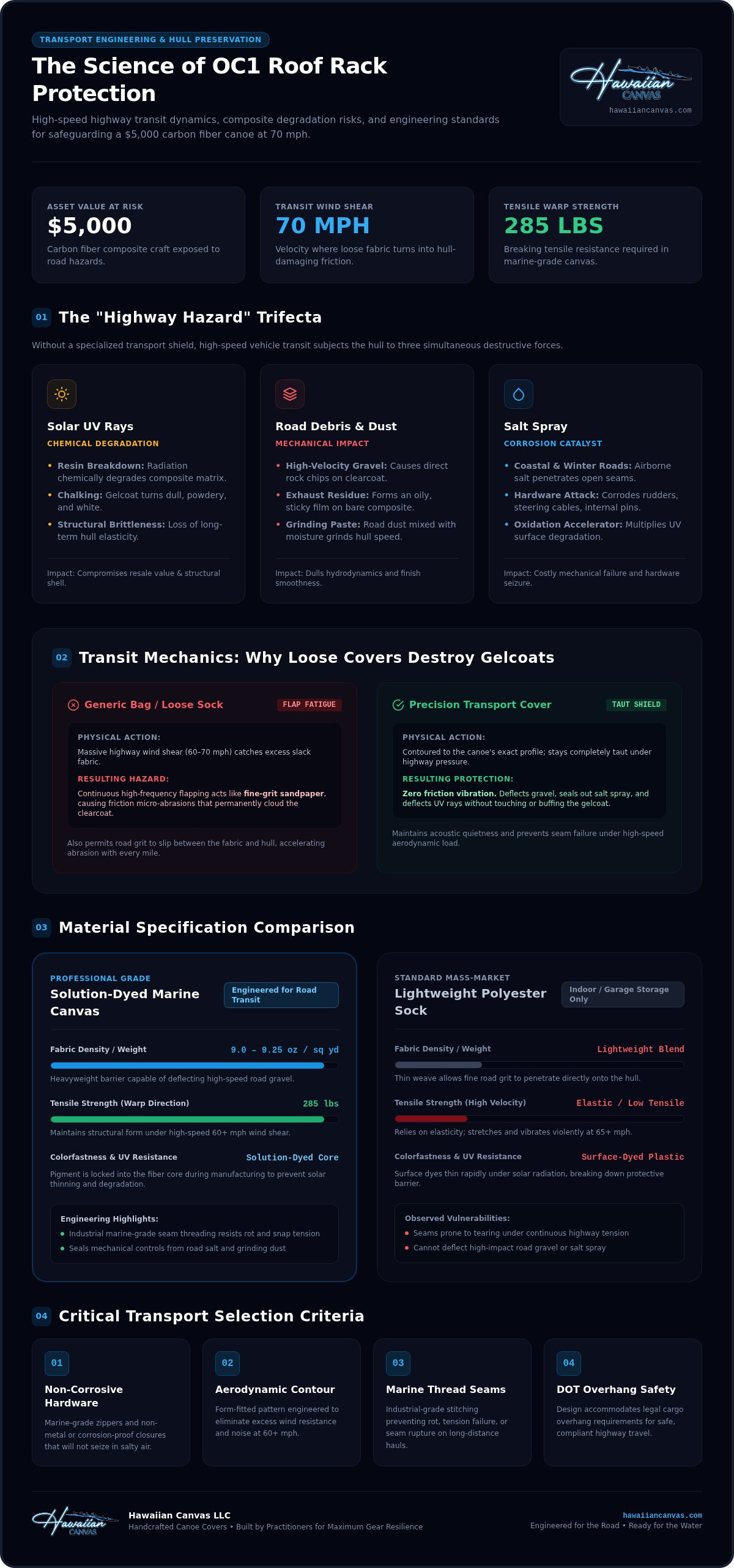
A high-performance outrigger canoe is a precision instrument. It's designed for the water, but it spends a significant portion of its life on a vehicle. High-speed transport introduces a specific set of risks that a standard storage bag isn't built to handle. An OC1 roof rack cover serves as a specialized transport shield. It manages the aerodynamic pressure and physical hazards encountered when your craft is mounted on automobile roof rack systems. Without this barrier, your hull is at the mercy of the "Highway Hazard" trifecta: UV rays, road debris, and salt spray.
To better understand the mechanics of safe transport, watch this helpful video:
A loose storage bag is meant for the garage. A transport-ready cover is engineered for the road. The difference is found in the material weight and the tension of the fit. Road transport at highway speeds creates massive wind shear. If a cover is loose, it flaps. This flapping acts like fine-grit sandpaper against the gelcoat. A proper OC1 roof rack cover stays taut, protecting the hull from rock chips and the oily film of exhaust residue that accumulates during long hauls.
Protecting the Gelcoat from Oxidation
Solar exposure is a constant threat. UV degradation in marine composites is the chemical breakdown of the resin matrix caused by ultraviolet radiation. This process leads to "chalking," where the finish becomes dull, white, and powdery. Beyond aesthetics, oxidation makes the hull brittle and prone to structural issues. A professional-grade cover blocks the vast majority of UV rays, preserving the deep luster of the gelcoat. The cost of a quality cover is a fraction of what a professional gelcoat restoration or structural repair requires.
Safeguarding Against Road Grime and Salt
Coastal driving and winter roads introduce salt spray. This isn't just a surface issue. Salt is a catalyst for corrosion that targets metal components like rudders, cables, and internal hardware. An effective cover provides a sealed environment, keeping corrosive elements away from sensitive mechanical parts. It also blocks abrasive road dust. On long trips, this dust combines with moisture to form a grinding paste. A heavy-duty barrier ensures that road grime never touches the composite surface, maintaining the hull’s speed and efficiency.
Marine-Grade Materials: Engineering for Resilience
The integrity of an OC1 roof rack cover depends entirely on its raw components. Most mass-market options use lightweight polyester blends. These fabrics offer minimal protection against high-velocity road debris. Professional-grade covers utilize 100% solution-dyed acrylic, such as marine-grade Sunbrella. This material weighs approximately 9.0 to 9.25 oz per square yard. It provides a breaking tensile strength of 285 lbs in the warp direction. This industrial strength ensures the cover remains stable under the extreme wind shear of highway travel.
Cheap stretch "socks" rely on elasticity. While convenient for indoor storage, they are detrimental during transit. The thin weave allows road grit to penetrate and reach the hull. At 65 mph, this grit vibrates against the gelcoat. It creates a dulling effect that compromises the canoe's speed and finish. High-quality canvas creates a physical barrier. It's thick enough to deflect gravel and resilient enough to withstand years of exposure. Every seam should utilize industrial-grade thread designed for marine environments. This prevents the stitching from rotting or snapping under tension.
Safety is the primary concern when properly securing your cargo for long distances. A cover that fails at the seams becomes a road hazard. Heavy-duty construction ensures the bag stays intact, keeping your craft safe and other drivers out of danger. Investing in a handcrafted canoe cover ensures these engineering standards are met for every mile of your journey.
UV Resistance and Color Fastness
Marine-grade canvas is engineered for the sun. Solution-dyed fabrics lock the pigment into the fiber during the manufacturing process. This prevents the "thinning" effect common in cheaper, surface-dyed plastics. A heavy-duty rating requires high abrasion resistance. Top-tier marine fabrics typically handle 40,000 double rubs in standardized testing. This durability means the cover won't wear through after a single season of roof rack contact. It maintains its structural integrity and protective properties long after generic fabrics have faded and brittle.
Reinforced Stress Points for Transport
A canoe experiences localized pressure at the bow, the stern, and the cradle contact points. A well-built cover features double-layered canvas in these critical impact zones. This reinforcement prevents the fabric from wearing thin where it meets the rack hardware. Breathability is equally important. Marine canvas allows moisture to escape while blocking liquid water. This prevents condensation from being trapped against the hull. Without airflow, trapped heat and moisture can lead to osmotic blistering in high-heat environments, permanently damaging the composite resin.
Custom Fit vs. Generic Canoe Socks: A Transport Comparison
Physics dictates how your gear behaves at 65 mph. At these speeds, loose fabric is more than an annoyance. It becomes a source of "flap fatigue." This occurs when wind pressure causes unsecured material to vibrate rapidly against the hull. This constant oscillation acts as a mechanical abrasive, wearing down the gelcoat and clearcoat finishes we discussed previously. A high-quality OC1 roof rack cover relies on a precision fit to eliminate this movement. By maintaining a streamlined profile, the cover remains silent and stable, ensuring the fabric protects the canoe rather than damaging it.
Custom closures provide a level of security that generic elastic drawstrings cannot match. While drawstrings are prone to slipping under tension, heavy-duty marine zippers and reinforced Velcro keep the cover anchored. This is critical for maintaining an aerodynamic shape. Research on protective marine covers confirms that tensioning is the primary factor in preventing wind-induced wear. A tailored design ensures that every square inch of canvas is under the correct amount of tension, regardless of the wind direction or vehicle speed.
Precision Tailoring for OC1 Hulls
Every canoe model has a unique geometry. Precision tailoring accounts for the specific rocker, beam, and length of your craft. It also includes dedicated openings for iakos. These allow you to transport the hull while it's fully rigged, providing a snug seal around the connection points. This reduces overall wind resistance, which improves vehicle stability and fuel economy during long hauls. A tight fit ensures the cover stays put even when passing large trucks or facing heavy crosswinds. This stability is the hallmark of a master craftsman's approach to gear design.
The Problem with Generic "Socks"
Generic stretch socks are often made from thin polyester or Lycra. These materials offer almost zero protection against puncture or impact from flying road gravel. Because they stretch, they also have a porous weave. This weave traps road grit and salt against the hull. Once trapped, the grit acts like a sanding block every time the wind catches the fabric. Additionally, loose fabric can sag or shift during transit. This creates dangerous drag and can potentially obscure your vehicle’s brake lights or turn signals, creating a safety liability on the highway.
Selection Criteria for Professional Transport Covers
Choosing the right OC1 roof rack cover requires a balance of mechanical durability and practical utility. A cover that is difficult to secure often ends up left in the garage. For the solo paddler, ease of installation is paramount. You need a design that allows for quick loading without sacrificing the tension required for highway speeds. Look for integrated safety features like reflective strips. These are essential for night travel, ensuring your 21-foot craft is visible to other drivers during low-light conditions.
Reliability starts with the manufacturer. A handcrafted cover reflects a level of precision that mass-produced bags lack. It shows in the alignment of the seams and the quality of the hardware. When you invest in a professional transport shield, you're buying peace of mind for the road ahead. You can order a custom-fitted hull cover to ensure every component meets these rigorous standards.
Hardware and Closure Durability
Saltwater environments are brutal on metal. Standard zippers will seize or corrode within months. A professional transport cover utilizes non-corrosive hardware, such as heavy-duty YKK #10 marine-grade soft coil zippers or high-tensile Delrin tooth zippers. These materials resist salt calcification and provide smooth operation even after years of use. Velcro closures should be industrial-strength and wide enough to maintain a grip under wind load. Ensure that all straps and buckles are positioned to avoid contact with the vehicle paint or the canoe hull to prevent scratching.
Breathability and Mold Prevention
Waterproofing is often misunderstood. While you want to block road spray, a 100% waterproof cover can trap internal moisture. This leads to osmotic blistering, a condition where trapped moisture creates pressure pockets in the composite resin. A breathable marine canvas allows moisture from a damp cockpit to evaporate while still repelling exterior rain. This thermal regulation is a core topic in The Ultimate Guide to Custom Outrigger Canoe Covers. Maintaining airflow is the only way to prevent mold and hull damage in humid climates.
Handcrafted Resilience: The Hawaiian Canvas LLC Difference
True protection is not found in a factory. It is built by those who live on the water. Mass-market options prioritize low costs and high volume. These disposable bags often fail when the environment becomes demanding. Artisanal gear offers a different standard. Every OC1 roof rack cover produced by Hawaiian Canvas LLC is the result of a specialized manufacturing process. We focus on doing one thing exceptionally well: safeguarding your canoe against the elements. This master craftsman approach ensures that every stitch and seam serves a functional purpose.
Resilience is built into the fabric. We use heavy-duty, marine-grade materials that resist the abrasive nature of road salt and the corrosive power of UV rays. This isn't marketing hype. It is a commitment to longevity. A handcrafted cover outlasts generic alternatives by years, maintaining its structural integrity through thousands of miles of transport. You aren't just buying a bag. You are investing in a piece of equipment designed to preserve your craft for the long haul.
Built for the Real Ocean Environment
Practitioner experience informs every design choice. We understand the vulnerabilities of a high-performance canoe because we paddle them ourselves. This knowledge leads to specialized solutions like reinforced rudder caps and the integration of a padded canoe seat with bottle holder for post-paddle comfort. Our gear is tested in high-UV and high-salt environments. These conditions cause standard fabrics to thin and become brittle. By using materials engineered for ocean resilience, Hawaiian Canvas LLC provides a sense of security for the paddler. If you manage a fleet, see our OC6 Canoe Storage Covers: The Complete Fleet Protection Guide for professional-grade storage solutions.
Global Shipping for Specialized Gear
High-performance protection should be accessible to everyone. Hawaiian Canvas LLC offers global shipping to ensure paddlers worldwide can access our custom-fit designs. The ordering process is methodical and precise. We maintain patterns for various OC1 models to ensure a snug, aerodynamic fit that prevents flap fatigue. This precision tailoring is what separates a professional OC1 roof rack cover from a generic storage bag. Every order is handled with the same respect for the craft and the environment in which it is used. Protect your investment with a handcrafted OC1 cover today.
Securing the Future of Your Craft
Your canoe is more than just equipment; it's an investment in your lifestyle. Ensuring it survives the highway is just as important as how it performs on the water. A custom-engineered OC1 roof rack cover provides the physical barrier needed to repel road salt, deflect debris, and block destructive UV rays. By choosing a tailored fit over a generic sock, you eliminate the vibration and friction that dulls your gelcoat over time.
Resilience on the road comes from specialized materials and artisanal construction. Every cover we make is handcrafted in Hawaii using marine-grade, UV-resistant fabrics built to withstand the harshest ocean conditions. We understand the specific needs of practitioners because we use this gear ourselves every day. With global shipping available for all our paddling gear, professional protection is accessible to the entire paddling community.
Don't let your next trip to the water be the one that damages your hull. Order Your Handcrafted OC1 Transport Cover today and travel with the confidence that your craft is secure. We'll see you on the water.
Frequently Asked Questions
Can I leave my OC1 roof rack cover on during long-term outdoor storage?
Yes, you can leave a high-quality cover on during storage, provided the material is breathable. Our marine-grade fabrics allow moisture to evaporate, which prevents internal heat buildup and osmotic blistering on the hull. This is a significant advantage over plastic-based covers that trap humidity. For the best results, ensure the canoe is clean and dry before sleeving it for long-term storage in high-UV environments to maintain the gelcoat integrity.
Will a custom OC1 cover fit multiple different canoe models?
A custom OC1 roof rack cover is designed for a specific hull geometry and won't fit multiple models properly. Because every canoe has a unique rocker, length, and beam, a precision fit is required to prevent fabric movement. A cover that is too large will flap at highway speeds, while one that is too small puts undue stress on the zippers. We maintain specific patterns for various models to ensure an aerodynamic fit.
How do I clean road salt and grime off my marine-grade cover?
Use fresh water and a mild, non-detergent soap to clean your cover after long trips. Rinse the fabric thoroughly to remove road salt and grime that accumulates during transport. It's important to avoid harsh chemicals or power washers, as these can damage the UV-resistant finish and the integrity of the industrial stitching. Allow the cover to air dry completely before folding it for storage to prevent any mold from forming in the fibers.
Is it safe to drive at highway speeds with a canoe sock?
Driving at highway speeds with a lightweight stretch sock is not recommended for long-distance transport. These fabrics are designed for dust protection in a garage, not the 70 mph wind shear encountered on the road. Socks often flap violently, which traps road grit against the hull and creates friction damage. A heavy-duty transport cover remains stable and silent, providing a genuine physical shield against the hazards of the highway.
Do I need a separate cover for my ama and iakos during transport?
Yes, utilizing a separate ama cover and individual iako sleeves is the standard for professional transport. Protecting these components prevents them from scratching the main hull or suffering damage from flying road debris. Hawaiian Canvas LLC offers specialized sleeves designed to fit these parts securely. This ensures that every piece of your rig is shielded from salt spray and UV exposure, preserving the total resale value of your outrigger canoe system.
How do I prevent my cover from flapping and scratching the gelcoat?
The most effective way to prevent flapping is to use a cover tailored to your specific canoe model. A precision fit ensures there is no excess material to catch the wind. You should also verify that all zippers and Velcro closures are fully engaged and that any integrated straps are tensioned correctly. This stability prevents the fabric from vibrating against the gelcoat, which eliminates the risk of friction-induced micro-abrasions during high-speed transit.
What is the average lifespan of a heavy-duty Sunbrella canoe cover?
A heavy-duty marine-grade cover typically has an operational lifespan of 3 to 8 years. This duration depends on your frequency of transport, the level of UV exposure, and how well you maintain the fabric. Solution-dyed acrylics are engineered for longevity and maintain their structural integrity much longer than mass-market polyester. Regular rinsing to remove salt and grime will extend the life of the material and keep the hardware functioning smoothly for years.
Does a roof rack cover protect against rock chips on the highway?
Yes, a heavy-duty OC1 roof rack cover acts as a resilient shield against rock chips and flying gravel. The weight of the marine-grade canvas, typically around 9 oz per square yard, is thick enough to deflect small impacts that would otherwise crack or chip a carbon fiber hull. This protection is essential during highway hauls where road debris is kicked up by other vehicles, ensuring your craft arrives at the water in pristine condition.