

How to Use Canoe Cockpit Covers to Protect Your Outrigger
A canoe cockpit cover isn't just an optional accessory; it's an essential hull-preservation tool. Whether you're battling relentless sun that oxidizes your gelcoat or rigging heavy-duty outrigger canoe spray skirts for demanding open water, an exposed interior will cost you. You already know the headache of discovering gallons of stagnant rainwater pooled in your footwells, or the gut punch of watching an unsecured cover rip free on the highway.
Master the art of protecting your canoe's interior from UV damage and water ingress with professional-grade cockpit management. When you dial in your deck protection, you guarantee a bone-dry cockpit after severe weather, protect your boat's resale value, and slash minutes off your setup routine at the launch. Here is how to install, secure, and maintain your covers to keep your outrigger clean, light, and completely race-ready.
Key Takeaways
- Learn the functional differences between protective storage covers and heavy-duty outrigger canoe spray skirts designed for rough water.
- Dial in your alignment sequence to eliminate canvas sag, cockpit water pooling, and transport hazards on the highway.
- Safeguard your canoe's interior gelcoat and footwells against severe UV degradation to preserve long-term resale value.
- Establish a reliable maintenance routine with post-paddle freshwater flushes to protect water repellency and prevent hardware corrosion.
- Discover why ocean-tested, handcrafted construction provides far better resilience against tropical salt exposure than mass-produced imports.
Understanding Canoe Cockpit Covers: Protection vs. Performance
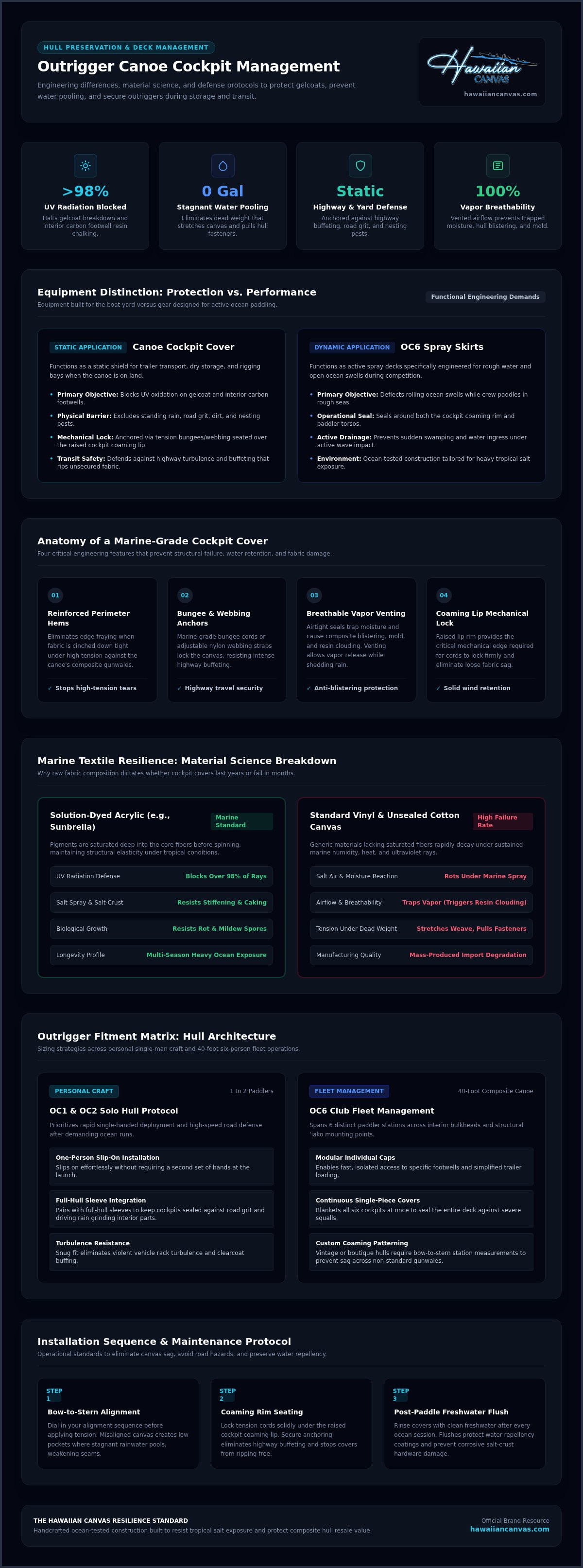
Paddlers often confuse equipment built for the water with gear designed for the boat yard. A canoe cockpit cover serves as a static shield for trailering, dry storage, and rigging bays. In contrast, active OC6 spray skirts function as dynamic spray decks that deflect rolling swells while your crew paddles in rough seas. Traditional paddling guides often blur the line between spray skirts and cockpit covers, but their engineering demands are completely different.
Storage covers focus on defense. The primary objective is preventing UV oxidation on expensive gelcoats and interior carbon footwells. Intense sun exposure breaks down resins, causing microscopic chalking and fading that degrade hull value. The secondary goal is physical exclusion. Reliable covers keep out standing rain, debris, road grit, and nesting pests, ensuring your hull remains clean and ready to launch.
The Anatomy of a High-Quality Cockpit Cover
A dependable cover handles high tension without tearing. Reinforced perimeter hems stop edge fraying when the fabric is cinched down hard against the gunwales. Marine-grade bungee cords or adjustable nylon webbing straps anchor the cover, preventing highway buffeting from ripping it off the rack. Crucially, a storage cover must breathe. An airtight seal traps ambient moisture against the composite hull, triggering blistering, mold, and resin clouding. Proper venting allows internal moisture to escape while shedding exterior downpours.
Why Material Choice Dictates Longevity
Salt air destroys cheap fabrics quickly. Standard vinyl and unsealed cotton canvas rot under persistent marine salt spray and humidity. Solution-dyed acrylic, such as marine-grade Sunbrella, utilizes pigments saturated deep into the core fibers to resist rot, mildew, and salt-crust stiffening over seasons of hard use. In the realm of high-performance custom outrigger canoe covers, true UV-resistance means blocking over 98% of harmful solar radiation before it ever reaches your vulnerable interior bulkheads. Choosing purpose-built marine textiles ensures your canoe cockpit covers and outrigger canoe spray skirts endure years of heavy ocean exposure.
Choosing the Right Fit for Your Outrigger Model
Precision fit separates a cover that lasts years from one that fails in months. A solo OC1 features a compact cockpit opening, while a 40-foot OC6 presents six distinct paddler stations spanning across multiple bulkheads and ʻiako mounting points. If your canvas fits loosely, rainwater pools in the low points. That dead weight stretches the weave, weakens seams, and pulls fasteners straight out of the composite hull.
A secure installation depends heavily on the cockpit coaming. This raised lip along the cockpit rim provides the mechanical edge needed to seat tension cords securely. While active outrigger canoe spray skirts seal around both the coaming and the paddler during competition, storage covers must lock solidly over the lip to resist heavy winds. Older, vintage, or boutique hulls often lack uniform lip dimensions. If your canoe features non-standard gunwale widths or unusual bulkhead positioning, generic covers will sag; you'll need accurate bow-to-stern station measurements to ensure proper custom patterning.
OC1 and OC2 Personal Craft Considerations
Personal canoes require speed and simplicity. An effective solo cover slips on effortlessly after a brutal downwind run, anchoring without needing an extra pair of hands. Road safety is equally critical. Highway speeds create violent turbulence behind a vehicle, and loose fabric can buff your clearcoat or rip away entirely. For cross-country travel, pairing a snug cockpit cap with a full-hull sleeve delivers complete protection. Similar to how the National Park Service paddling safety guidelines highlight keeping hulls sealed against water ingress, maintaining a sealed cockpit during transport prevents road grit and driving rain from grinding down interior components.
OC6 Fleet Management
Managing a canoe club fleet requires systematic organization. Standardizing canvas gear across identical club hulls eliminates confusion during trailer loading on busy race mornings. Fleet directors must choose between modular individual seat caps and continuous, single-piece covers that blanket all six cockpits at once. Individual caps offer fast access to specific footwells, while full-length covers seal the entire deck against severe squalls. To explore fleet-wide rigging strategies, review our comprehensive OC6 canoe storage covers guide. If your team paddles mixed hull designs, consult Hawaiian Canvas to match custom-built patterns directly to your club's specific models.
How to Install Your Canoe Cockpit Cover Correctly
Proper installation requires an exact sequence. Before stretching any marine canvas over your cockpit, wipe the entire rim clean. Salt crust, sand, and fine grit act like sandpaper when trapped beneath tensioned fabric, scouring your clearcoat with every gust of wind. Clean composite surfaces also give elastic hems and mechanical fasteners a firm, non-slip grip.
Once clean, orientation dictates your workflow. Align the cover bow-to-stern. High-performance outrigger canoe spray skirts require careful paddler-station alignment, and stationary storage covers demand that same methodical attention to tension points. Always work toward a drum-tight finish. If the center dips or ripples, water will settle in the low spot during a sudden squall. Give every bungee toggle or perimeter clip a firm tug test before you hit highway speeds.
Step-by-Step Installation Guide
- Drape the canvas: Lay the cover evenly over the cockpit coaming, orienting the reinforcement patches toward high-friction points.
- Lock the bow anchor: Hook the forward nose pocket or primary bungee loop securely under the forward coaming lip.
- Roll down the rails: Work backward symmetrically along both port and starboard gunwales, pulling the perimeter elastic smoothly over the lip.
- Seat the stern: Pull the aft hem down and back, tensioning the final shock cord around the rear bulkhead edge.
- Check for sag: Press the center deck lightly; the fabric should snap right back without lingering slack.
Troubleshooting Common Fit Issues
Elastic cords naturally lose tension after seasons under punishing solar heat. Replace tired bungees immediately or thread adjustable cord locks to take up the slack. For large, open OC6 cockpits prone to mid-span sagging, tucking an inflatable beach ball beneath the canvas creates an effective dome that sheds standing water effortlessly. As detailed in BoatUS guidelines on marine-grade cover maintenance and fabric care, continuous tenting prevents fabric stretching and keeps moisture moving off the material. Finally, inspect your steering cables on ruddered craft. Never pinch foot-pedal lines under tensioned perimeter hems, or you risk kinking stainless wires and distorting your cover's seal.
Maintenance and Care for Marine-Grade Covers
Salt water leaves behind jagged microscopic crystals as it evaporates. Over time, these dried crystals work between woven fibers like tiny razor blades, abrading the yarn every time the fabric flexes. A thorough freshwater flush after every ocean paddle isn't optional; it's mandatory. Just like competition outrigger canoe spray skirts that battle continuous chop, stationary cockpit canvas quickly degrades if brine is left to bake under direct sun.
Storage protocol determines lifespan. Never fold, roll, or bag a damp cover. Trapping residual moisture against woven acrylic generates mildew blooms and promotes osmotic blistering if resting on composite decks. Inspect your canvas regularly for telltale warning signs: thread whitening at stress points, thinning along the gunwale contact patches, or micro-cracks in elastic tension cords before a highway failure catches you off guard.
Removing Salt and Grime
Standard household detergents strip the factory water-repellent finish off technical fabrics. Mix one-quarter cup of mild liquid soap into a gallon of lukewarm water to lift stubborn salt crust without degrading the solution-dyed acrylic. Work the lather gently across soiled sections using a soft-bristle horsehair brush to dislodge salt residue without fraying the weave. Always hang or stretch your washed canvas flat in a well-ventilated, shaded area until it dries completely before long-term storage.
Longevity Tips for Club Equipment Managers
Rigorous use across multi-paddler teams demands scheduled maintenance. Establish seasonal inspections across all club gear to catch loose binding and frayed hem edges early. When managing a fleet alongside dedicated outrigger canoe club gear, keep zippers, snaps, and turn buttons functioning smoothly by treating them with a non-petroleum marine lubricant twice a year. If damage is limited to a single blown seam or a loose grommet, a quick repair will extend service life; if the fabric feels stiff, brittle, or leaks under light rain, retire the unit. When your club's outrigger canoe spray skirts or storage caps reach the end of their operational life, order handcrafted marine covers from Hawaiian Canvas to restore complete deck protection.
The Hawaiian Canvas Standard: Handcrafted Resilience
Paddling in Hawaii demands gear built for uncompromising ocean conditions. The combination of intense ultraviolet radiation, high-salinity trade winds, and pounding open-ocean swells quickly destroys mass-produced gear. We handcraft our outrigger canoe spray skirts and cockpit covers from direct experience on the water, designing each piece as fellow practitioners who understand the physical reality of the elements.
Mass-produced imports rely on generic cuts and lightweight thread that unravel under highway transport tension. In contrast, our workshop builds every piece in Hawaii using heavy-duty, marine-grade Sunbrella and corrosion-proof hardware. Professional-grade cockpit protection eliminates the chore of bailing standing water, preserves your hull's resale value, and keeps your focus where it belongs: on the water.
Handcrafted Precision
A cover is only as tough as its weakest seam. Heavy-duty bonded threads, reinforced high-friction corners, and precision edge-binding ensure our canvas withstands years of brutal tension. We tailor each piece to specific hull geometries, whether you need a streamlined cover for an individual V1 or specialized OC6 racing covers engineered for grueling channel crossings. Our build philosophy remains straightforward: build it strong, build it right, and build it to endure.
Ordering Your Custom Protection
Every outrigger hull features subtle differences in coaming width, bulkhead spacing, and ʻiako placement. When ordering, simply specify your canoe model so our craftsmen can cut and sew the exact pattern for your hull. We consult directly with club directors and equipment managers to outfit entire fleets with uniform, dependable canvas. We ship direct to paddlers across the country, bringing durable, ocean-tested protection straight to your coastline. Outfitting your craft with proven outrigger canoe spray skirts and custom cockpit covers guarantees your investment stays race-ready through every season.
Lock Down Your Deck and Safeguard Your Investment
Taking care of your canoe's cockpit comes down to disciplined habits and the right equipment. Proper drum-tight installation stops standing water from stretching your canvas, while routine freshwater rinses keep abrasive salt crystals from grinding through technical fibers. Whether you are rigging dynamic outrigger canoe spray skirts for open-ocean swells or buttoning up your hull after a long training session, disciplined cockpit management preserves your composite interior for years to come.
Cut corners with lightweight imports, and relentless UV exposure will eventually collect its toll on your gelcoat. Our workshop builds dependable gear using UV-resistant Sunbrella fabric and heavy-duty marine-grade hardware. Handcrafted in Hawaii by paddlers who understand the reality of ocean wear, each cover provides uncompromising protection against the elements. Secure your craft with handcrafted cockpit covers today, and keep your outrigger clean, dry, and always ready for the next run.
Frequently Asked Questions
Do I really need a cockpit cover if I store my canoe under a roof?
Yes, indoor and covered storage still exposes your hull to dust, airborne moisture, spiders, and reflected ultraviolet light. Open bays and carports don't stop wind-driven dirt from settling in footwells and grinding into the gelcoat. A snug cockpit cover seals out grit, stops pests from setting up nests inside the hull cavity, and keeps your rigging clean so you spend less time prepping before morning launch sessions.
Will a cockpit cover stay on my outrigger during highway transport?
Yes, provided it is patterned correctly with marine-grade shock cords or reinforced tie-downs. Generic tarps flap and shred at high speeds, but custom-fitted covers grip beneath the coaming lip to deflect violent wind shear. For long-distance trailering down the interstate, double-check your bow anchor tension, ensure no loose fabric edges catch air, and inspect tie-downs before merging onto the highway.
How do I prevent water from pooling on top of my OC6 cockpit cover?
Achieving drum-tight perimeter tension is the first defense against water pooling. For wide cockpits or multi-seat spans on an OC6, place an inflatable vinyl float, foam block, or small dome support beneath the fabric before securing the edges. This creates a gentle pitch that sheds heavy rainfall immediately, protecting the acrylic weave from stretching under the dead weight of stagnant water during severe storms.
Can I use a cockpit cover while the canoe is on the water?
No, cockpit covers are designed strictly for stationary storage and trailering. Using a static cover while paddling is dangerous because it lacks emergency quick-release exits and cockpits for paddlers. For open water and active paddling, you need dedicated outrigger canoe spray skirts. These racing skirts deflect breaking swells and water intrusion around paddlers while allowing unhindered stroke mechanics and rapid wet-exit egress.
What is the best way to clean bird droppings or tree sap off my cover?
Let bird droppings dry completely, then gently scrape off the crust with a plastic scraper before washing. For sap and stubborn residue, soak the spot with a mild solution of liquid dish soap and lukewarm water. Work the fabric using a soft-bristle brush, rinse thoroughly with fresh water, and air dry in the shade. Never use solvent-based cleaners or pressure washers, which destroy protective fluorocarbon coatings.
How long should a high-quality Sunbrella cockpit cover last?
A marine-grade Sunbrella cover routinely delivers five to ten years of dependable service when properly maintained. The solution-dyed acrylic resists rot, mildew, and solar fading far better than standard synthetic canvas. Rinsing salt spray after ocean sessions and storing the fabric completely dry are the two most critical factors in extending the working life of your cover's stitching, fabric coating, and elastic hardware.
Can I get a custom cover for an older or modified outrigger canoe?
Yes, older and vintage canoes frequently require tailored fabrication due to unique bulkhead placements and varying gunwale profiles. Unlike mass-market suppliers who only support modern production lines, custom craft workshops pattern covers to your exact hull measurements. Handcrafted builders can accommodate specialized rig setups, widened cockpits, and modified outrigger canoe spray skirts to guarantee a tight, secure seal regardless of your hull's age.
Do cockpit covers protect against rodents or insects?
Yes, a taut cover with a continuous perimeter seal physically blocks wasps, geckos, spiders, and mice from nesting in dark footwells. Composite hulls offer an inviting shelter for pests during prolonged dry storage. By anchoring firmly over the coaming rim, your canvas prevents vermin from chewing internal foam blocks, fouling control cables, or leaving corrosive droppings inside your canoe during the off-season.