

Canoe Seat Pads for Long Distance: How to Compare Comfort and Fit
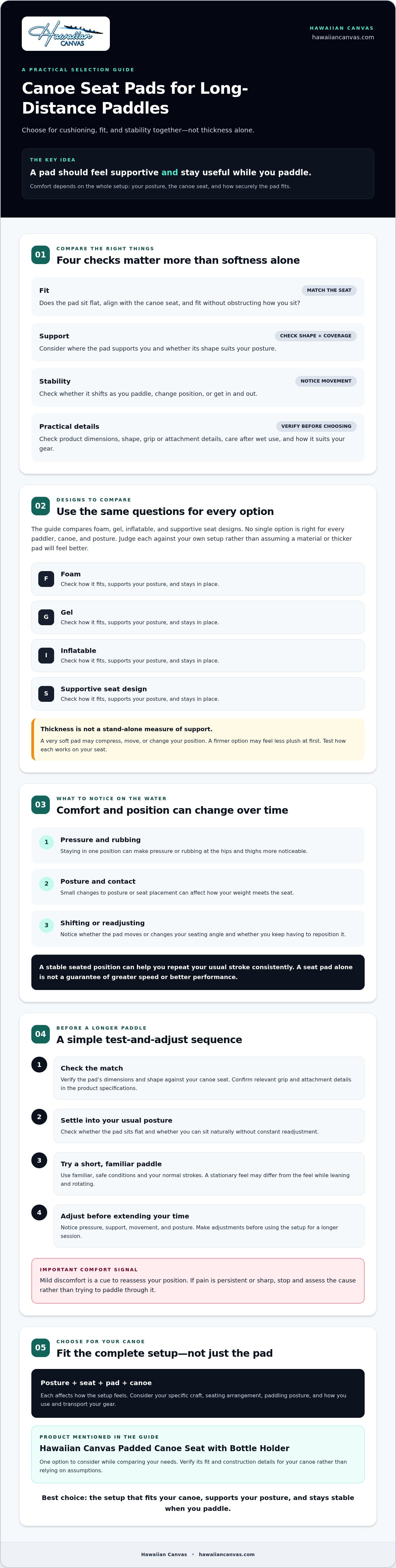
A thicker pad isn’t always the better choice for a long paddle. Extra height or softness can change your seating position, affect how steadily you transfer power, or leave you shifting to find support. Choosing canoe seat pads for long distance means balancing cushioning with a stable fit.
If discomfort builds over hours on the water, product descriptions can feel like guesswork. Thickness alone won’t tell you how a pad will feel or whether it will stay put. The right setup depends on where you feel pressure, how you sit and paddle, and how securely the pad fits your canoe seat.
This guide compares foam, gel, inflatable, and supportive seat designs, along with their fit, stability, and practical trade-offs. You’ll learn what to check against your canoe and paddling posture, and what to test before a longer session. Hawaiian Canvas also offers a Padded Canoe Seat with Bottle Holder, one option to consider as you compare your needs.
Key Takeaways
- Compare cushioning, shape, and coverage separately. Thickness alone doesn’t show how a pad will support your posture.
- When evaluating canoe seat pads for long distance, check how each option fits your canoe and whether it stays stable as you paddle.
- Weigh basic cushioning, shaped support, and padded-seat options against your comfort needs and paddling style.
- Test the setup in familiar, safe conditions, then adjust it before extending your time on the water.
- Before choosing a purpose-made seat, verify its fit and practical details for your canoe rather than relying on assumptions.
Why Canoe Seat Pads Matter on Long-Distance Paddles
A canoe seat pad is an added layer placed on or attached to a seat to change how it feels under the paddler. It may provide cushioning or change how your body meets the seat, but it can’t compensate for a poor fit or awkward paddling position. When comparing canoe seat pads for long distance, assess the whole setup: your posture, seat, and canoe all affect comfort.
Comfort can change over time. As you paddle, the same contact points remain under pressure, posture may shift, and fatigue can make small fit issues more noticeable. A pad that feels comfortable at the put-in may feel different after an extended stretch on the water. Long-session comfort depends on a pad that fits the seat and supports a stable paddling position.
What changes during a longer paddle?
Staying in one position for a long time can make pressure or rubbing at the hips and thighs more noticeable. The experience varies with the paddler, canoe, posture, and water conditions, so there’s no single pad that feels right for everyone. Mild discomfort is a cue to reassess your position; persistent or sharp pain is different. Stop when it occurs and assess the cause rather than trying to paddle through it.
Small changes to posture or seat placement may affect how your weight meets the seat. A pad can change that contact, but it’s only one part of the setup. Seat shape and canoe design matter too. For context, a touring or tripping canoe is designed with longer journeys and gear in mind, so consider the specific craft and seating setup you’ll use.
Why softness alone is not a reliable comparison
A very soft pad may feel appealing in your hand, but that doesn’t show how it will support you while seated and paddling. Depending on its shape, placement, and the seat beneath it, it may compress, move, or change your position. A firmer option may feel less plush at first but provide a more stable surface for your setup. Test rather than assume.
Compare practical factors, not just cushioning:
- Fit: Does the pad sit appropriately on your canoe seat?
- Support: Do its shape and coverage suit your posture?
- Movement: Does it stay in place as you paddle?
- Care: Can you manage it after wet use?
- Practical features: Does it suit how you use and transport your gear?
These checks offer a more useful comparison than softness alone. Next, use them to weigh different seat-pad designs against your canoe and paddling needs.
How Seat-Pad Design Affects Support, Pressure, and Position
Seat-pad design combines features that do different jobs. Cushioning describes the feel; fit and stability determine whether that feel stays useful while you paddle. A soft pad may cushion contact but still be poorly matched to the seat. A shaped pad may support specific areas, yet feel awkward if its contours don’t suit your posture. Compare these qualities separately.
Position matters, too. If a pad is too large, shifts under movement, or changes how you sit, it could make it harder to maintain a steady posture. The effect depends on the pad, canoe, and paddler. A stable seated position can help you repeat your usual stroke consistently, but don’t assume a seat pad will increase speed or improve performance on its own.
Cushioning and contact-area coverage
Look at where the pad supports you, not just how soft it feels in your hand. A narrow pad may cushion one contact area while leaving another unsupported. A broader shape may cover more of the seat but still not suit every paddler or canoe. Consider your usual position and whether the pad’s coverage fits the seat without obstructing how you sit. Verify product dimensions and shape rather than guessing.
Judge the support during a short paddle. Notice whether pressure feels evenly distributed or concentrated in an unfamiliar spot. A pad that feels comfortable while stationary may feel different as you lean and rotate through normal strokes.
Fit, grip, and movement on the seat
Check the pad against the canoe seat before a long outing. Does it sit flat and align with the seat? Does it move as you shift, paddle, or get in and out? Even a small slide can become a distraction if you keep having to reposition it. Grip surfaces and attachment methods vary by product, so confirm those features in the manufacturer’s specifications.
Use your regular paddling posture when assessing stability. If the pad changes your height or seating angle, notice whether you can still settle naturally and paddle without constant readjustment. For general paddling safety and technique guidance, consult the American Canoe Association. Hawaiian Canvas offers a Padded Canoe Seat with Bottle Holder; confirm its fit and construction details for your canoe before choosing it.
For canoe seat pads for long distance, the practical comparison isn’t simply soft versus firm. Assess cushioning, coverage, fit, and movement together, then test the combination on the water. The next section compares common seat-pad options.
Comparing Canoe Seat Pads for Long Distance: What to Weigh
Compare options by how they fit your canoe and perform in your usual paddling position, not by category name alone. This table is a starting point for assessing canoe seat pads for long distance. Grip, attachment, dimensions, and cleaning instructions vary by product, so confirm them before deciding.
| Option | Fit | Perceived support | Stability | Care | Suitability for your setup |
|---|---|---|---|---|---|
| Basic cushioning | Check whether its shape and dimensions suit the seat; varies by product. | Primarily adds a cushioning layer; feel depends on the pad and paddler. | Grip or attachment is product-dependent; check specifications. | Follow the manufacturer's care guidance. | May suit a paddler seeking a simple add-on, if it stays aligned and fits the seat. |
| Shaped support | Contoured shape may suit some paddlers and seats, but fit must be verified. | Support depends on where the shape makes contact. | Movement and attachment details vary; test on the water. | Care instructions depend on materials and construction. | Consider if its contours match your position without changing it uncomfortably. |
| Purpose-made padded seat | Confirm compatibility with your canoe and existing seat. | Depends on the seat design and how it suits your posture. | Construction and stability are product-specific; verify details. | Check the maker's instructions. | Worth considering if you want a more integrated seating option and its fit is confirmed. |
Cushion-only pads versus padded-seat options
An add-on cushion may be a straightforward way to change the feel of an existing seat, but don’t assume it will attach securely or fit every bench. A purpose-made padded seat is a different category. Check how it fits your canoe and whether it replaces or works with your current seating. Hawaiian Canvas offers a Padded Canoe Seat with Bottle Holder. Confirm its exact dimensions, fit, and construction before purchase.
When a bottle holder may matter
On a longer outing, having water within reach may be practical. Consider where a bottle sits, whether you can reach it without disrupting your stroke, and whether it interferes with entry, exit, or movement in the canoe. Don’t assume capacity, retention, or compatibility; verify those details for the specific seat. Paddling involves sustained movement, and Better Health Channel describes its potential contribution to aerobic fitness, strength and flexibility. Choose a seat that works with your own technique and routine.
No category is universally best. Match the option to the canoe seat, your posture, and the features you’ll use, then assess the fit before relying on it for a long paddle.
How to Test and Adjust a Seat Pad Before a Long Paddle
A pad that seems suitable on shore still needs to work when you’re seated, reaching for the paddle, and moving through a normal stroke. Test canoe seat pads for long distance in familiar, safe conditions before relying on a setup for an extended outing. Make one change at a time and note what you notice, so you can tell whether an adjustment helps.
Run a short-session fit check
Start with the canoe on stable ground, then check the pad on the water in conditions you know. Use your usual paddling posture and equipment. If the setup causes new instability or persistent discomfort, stop and reassess rather than pushing through.
- Check fit. Confirm the pad sits securely on the seat and doesn’t obstruct normal movement or access to equipment. Check that its position suits your usual seating posture.
- Paddle briefly. Use your regular stroke and reach. Notice whether the pad changes your seating angle or makes it harder to move naturally.
- Assess movement. Check whether it stays aligned through normal paddling, shifting, entry, and exit. Note any slipping or repeated need to reposition it.
- Record what you feel. Write down where discomfort occurs, whether your posture changes, and whether the pad moves. A short note helps you compare adjustments.
Adjust before adding distance
If something feels off, change one factor at a time. Depending on the product’s design and instructions, you might reposition the pad or reassess how it sits against the seat. Paddle briefly again and compare. Changing several things at once makes it difficult to identify what affected the result.
- Recheck alignment. Confirm the pad remains in place after getting in and out, then test it during normal movement on the water.
- Repeat the short test. Look for changes in comfort, stability, and posture. If the pad still shifts or interferes with your movement, reassess fit before increasing session length.
- Extend gradually. Once the setup feels stable in a short session, increase time on the water in familiar conditions. A brief test doesn’t guarantee comfort over a longer outing, so keep reassessing.
Don’t use repeated adjustments to dismiss recurring pain. Stop and consider qualified advice if discomfort persists or worsens. For broader product-selection context, read the padded canoe seat buying guide. If you’re comparing purpose-made options, explore Hawaiian Canvas’s padded canoe seat and verify its fit and details for your canoe.
Choosing a Long-Distance Seat Setup That Fits Your Canoe
The right setup suits your canoe, posture, and paddling style. A supportive pad that slides out of position may distract you; one that stays put but changes your seating angle may not feel right over time. Compare comfort and stability together, and verify product details rather than relying on a category label or product photo.
A final comparison checklist
- Fit: Check that the pad or seat matches your canoe’s seat and stays in position during ordinary paddling movement.
- Support: Consider where it makes contact and whether that coverage suits your usual posture.
- Movement: Confirm that it doesn’t interfere with your stroke, shifting position, or getting in and out of the canoe.
- Practical features: Decide whether features such as a bottle holder are useful in your setup.
- Care: Review the product’s care instructions and whether they suit how you use your gear.
Use the checklist as a filter, not a scorecard. A simple pad may suit one canoe and paddler, while a purpose-made padded seat may suit another. If fit, attachment, or care details aren’t clear, check the product listing or ask the seller before choosing.
What to verify before choosing
Confirm the current dimensions, materials, attachment method, and care instructions for the specific product. Check that its shape and fit suit your canoe, and test whether any extra feature works with your paddling posture. Hawaiian Canvas LLC is a paddler-operated business that handcrafts canoe and surf-ski gear. Its confirmed offerings include a Padded Canoe Seat with Bottle Holder, making it an option to investigate, not a universal recommendation. Verify its fit and product details against your boat and needs.
If you’re considering a more tailored seating approach, the custom padding for canoe seats guide offers additional context. Treat unresolved dimensions or compatibility questions as a reason to confirm specifics before buying.
Choosing canoe seat pads for long distance comes down to a dependable match between paddler, seat, and canoe. Test that match in familiar conditions, then adjust before extending your time on the water. To review the available gear, explore Hawaiian Canvas LLC paddling accessories.
Set Up for a More Comfortable Paddle
The best canoe seat setup isn’t simply the softest one. Compare how a pad fits your canoe, supports your usual posture, and stays in place through normal paddling movement. Test it in familiar conditions and make adjustments before extending your time on the water.
Those checks matter more than a product label. When comparing canoe seat pads for long distance, consider cushioning alongside fit, stability, care, and practical features you’ll actually use. A bottle holder, for example, may be useful if its placement works with your reach and paddling motion.
Hawaiian Canvas is a paddler-operated business that handcrafts gear in Hawaii. Its confirmed offerings include a Padded Canoe Seat with Bottle Holder, and its products use heavy-duty, UV-resistant materials. Verify the seat’s fit and current product details against your canoe before deciding.
Explore Hawaiian Canvas paddling accessories as you compare options and plan your setup. Check the fit and product details before heading out.
Frequently Asked Questions
What seat pad is best for long-distance canoe paddling?
There’s no single best pad for every paddler or canoe. Compare how its shape fits your seat, where it provides coverage, how it feels under you, and whether it stays aligned during normal movement. Try the complete setup in a shorter session before relying on it for a long paddle. Check current product dimensions and construction details, since these can determine whether a particular pad suits your canoe.
Do thicker canoe seat pads make long paddles more comfortable?
Not necessarily. Thickness alone doesn’t show how a pad fits, distributes contact, or stays stable on a particular seat. A thicker pad may also change your sitting position or paddling angle. Compare the complete setup and test it on the water in familiar conditions. Choose based on how the pad feels and behaves during paddling, rather than assuming extra cushioning means better comfort over a long distance.
How do I stop a canoe seat pad from sliding?
Start by checking whether the pad’s shape and dimensions suit the seat. Follow the manufacturer’s placement or attachment instructions, then see whether it shifts during ordinary paddling movement. Avoid improvised fixes that could damage the seat or interfere with movement. Test adjustments in familiar conditions before a longer outing. If the product information doesn’t explain how it attaches or should be positioned, ask the manufacturer for guidance.
Can I use a regular cushion as a canoe seat pad?
You can try one, but a household cushion may not fit securely or stay stable on a canoe seat. Consider whether its materials and care instructions suit the conditions where you’ll use it, and whether it allows a comfortable paddling posture. Test for movement in a short session before taking it on a longer paddle. A purpose-made padded seat is another option to compare, but confirm its fit for your canoe.
How should I test a canoe seat pad before a long-distance paddle?
Check the fit while seated, then paddle briefly in familiar conditions. Notice whether the pad shifts, changes your position, or creates a new pressure point. Adjust one factor at a time and repeat the test so you can tell what affects the setup. Extend your session only when it feels stable and comfortable. Stop and reassess if discomfort persists or the pad interferes with normal movement.
Is a canoe seat with a bottle holder useful for long-distance paddling?
It may be useful if the holder’s placement suits your reach and doesn’t interfere with your paddling movement. Check whether you can access your bottle from your usual seated position, and review current product details for the holder’s design. Hawaiian Canvas offers a Padded Canoe Seat with Bottle Holder, but confirm its fit and specifications for your canoe. Treat the holder as one practical feature to weigh alongside seat fit and stability.
How do I choose a seat pad for an OC1?
Start with the shape and dimensions of your OC1 seat, then compare whether a pad suits your usual position and stays aligned as you paddle. Check verified product specifications for compatibility rather than assuming a pad fits every craft. Test the setup in a short session first, paying attention to posture, movement, and comfort. Your on-water experience is a useful final check after reviewing the product details.