

Padded Canoe Seat with Bottle Holder: 2026 Buying Guide
What if the seat that looks most comfortable ends up crowding your paddling space? A padded canoe seat with bottle holder needs to work with your canoe, not just feel soft on shore. If the fit is off, the support doesn’t suit your position, or the bottle gets in the way, a useful upgrade can become a distraction on the water.
Start by checking the space where the seat will sit and how the seat is meant to stay in position. Then consider whether its support suits your paddling posture and whether you can reach the bottle without interrupting your stroke. These checks matter because canoe dimensions, nearby fittings, and holder placement can vary.
This 2026 guide explains how to assess fit, support, bottle access, and construction before you buy. You’ll find practical questions to ask about seat dimensions, attachment methods, materials, and bottle compatibility. Hawaiian Canvas offers a Padded Canoe Seat with Bottle Holder. Confirm the product’s specific fit and construction details before purchase.
Key Takeaways
- Measure your canoe’s seating area and compare it with confirmed seat dimensions.
- Ask how the seat is positioned and secured instead of assuming it will fit your canoe.
- Check bottle fit, holder position, and retention against your paddling movements.
- Choose based on your canoe setup, time on the water, comfort preferences, and preferred way to carry water.
- Hawaiian Canvas LLC offers a Padded Canoe Seat with Bottle Holder. Confirm its seat-specific construction and fit details with the maker.
Why Choose a Padded Canoe Seat with Bottle Holder?
A padded canoe seat with bottle holder combines a padded sitting surface with a designated place for a drink. The convenience depends on how well both parts work in your canoe. Padding changes how the seat feels beneath you, while the holder may keep a bottle close at hand. Neither feature is useful if the seat doesn’t suit your setup or the bottle interferes with your reach and stroke.
Consider the seat and holder as one system. Comfort depends on the seat, its fit, and your paddling position. Bottle placement matters too: a holder that seems easy to reach while stationary may be awkward once you’re paddling or shifting position. Think about where your arms and paddle move, and whether you can reach the bottle without changing your posture. For background on the broader activity and its different forms, see Canoeing.
What Does a Padded Canoe Seat with Bottle Holder Do?
The seat provides a padded place to sit, and the holder provides a spot for a bottle. To judge whether the combination is practical, check how the seat fits your canoe and whether the holder suits your bottle and paddling movement. Look for product-specific information about holder position, compatible bottle shapes or sizes, and how the bottle is retained. Don’t assume those details from the product name alone.
Padding can change the pressure and contact you feel across the sitting surface. That may feel different during a longer session, but it doesn’t guarantee lasting comfort or prevent injury. Consider your own experience and assess the seat as part of your full paddling position.
Who May Benefit from This Canoe Accessory?
Paddlers who want a bottle within reach may appreciate combining seating and bottle storage in one accessory. Before relying on that convenience, consider how the seat feels in your usual position and whether you can reach the holder while paddling. No single setup suits everyone.
A separate bottle holder or hydration pack may work better with a different canoe arrangement or personal preference. A separate holder gives you another component to position. A hydration pack carries water in a different way. Compare each option for fit, access, and interference with your movement rather than assuming one is automatically better.
How to Evaluate Fit, Support, and Stability Before You Buy
A seat can feel well padded and still be the wrong size or shape for your canoe. Before comparing comfort features, check the usable seating area, nearby fittings, and how the seat is intended to stay in position. A poor fit may restrict movement or make it harder to sit naturally. Don’t assume that a product fits every canoe or uses a familiar attachment method.
Measure the Canoe Seating Area
Measure the usable width and depth of the area where the seat will rest. Note nearby rails, fittings, cockpit edges, and other features that could affect placement. Compare your measurements with dimensions confirmed for the seat you’re considering. If the product information doesn’t list dimensions or clarify compatible canoe types, ask the maker before ordering.
Measure where the seat will actually sit, not just the widest part of the canoe. Check whether its expected position could overlap an edge or interfere with nearby equipment. Keep your measurements and a clear description of your canoe setup together so you can provide both when requesting fit guidance.
Check Support and Secure Positioning
Consider whether the seat supports your usual paddling posture and allows you to move naturally. If you can assess it in place, sit as you would while paddling and notice whether it shifts during ordinary movement. Ask how the seat is positioned and secured rather than assuming it uses straps, ties, or another attachment method. Claims of universal fit, improved stability, or injury prevention need product-specific evidence.
Seat movement can affect how you sit and reach through a stroke. Treat that as a practical fit consideration, not proof that a seat will make a canoe unsafe or unstable. For broader guidance on posture and preventing paddling injuries, consult the Better Health Channel. Seat comfort is one part of your overall paddling setup.
Before choosing a padded canoe seat with bottle holder, confirm its dimensions, compatible canoe types, and attachment details with the maker. For Hawaiian Canvas’s paddling gear, review the available product information and ask about any seat-specific details you can’t verify.
Does the Bottle Holder Stay Useful While You Paddle?
A bottle holder is useful only if you can reach it without twisting awkwardly, catching your paddle, or interrupting your stroke. Check its position from your normal seated posture. A dry run with the canoe stationary can help you see whether the bottle is within comfortable reach and whether your arm or paddle path meets the holder. An integrated design won’t suit every paddler or canoe setup.
Assess Reach and Bottle Retention
Check the holder’s position relative to your seat and paddling space. Ask which bottle shapes and sizes fit and how the bottle is retained. Capacity and fit aren’t interchangeable: a capacity figure alone may not tell you whether a bottle with a particular shape will work. Verify the product’s retention details rather than relying on appearance, especially if you expect the canoe to move or encounter changing water conditions.
Assess access from your usual position, without leaning or reaching across the canoe. If you need to shift your posture or alter your stroke to get the bottle, that placement may not suit your routine.
Compare Integrated and Separate Hydration Options
An integrated holder combines seating and bottle storage in one accessory. A separate holder gives you another component to position, while a hydration pack carries water another way. Each option has different fit and access considerations. Choose the arrangement that keeps water accessible while letting you move and paddle naturally.
| Option | Access to assess | Fit information to check | Possible movement interference |
|---|---|---|---|
| Integrated holder | Can you reach it from your seated position? | Holder position, bottle shape and size, retention | Check whether it crowds your paddle path or movement |
| Separate bottle holder | Can you place it within comfortable reach? | Mounting location and bottle compatibility | Check whether the added component gets in the way |
| Hydration pack | Can you access its drinking tube comfortably? | How it sits with your paddling setup | Check whether it restricts movement or distracts you |
For a padded canoe seat with bottle holder, confirm the holder’s dimensions, bottle compatibility, placement, and retention with the maker if those specifications aren’t published. Then consider your own reach and stroke. The practical choice is the setup that keeps water accessible without disrupting how you paddle.
Which Seat Features Matter for Your Canoe and Paddling Routine?
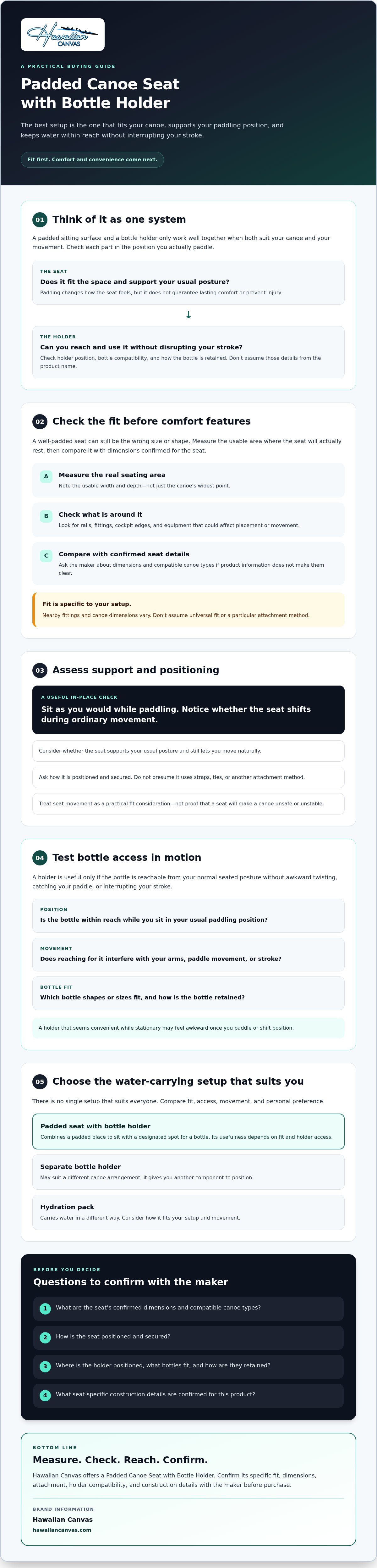
Choose features in order of importance, not by appearance alone. Start with your canoe setup, then consider your paddling routine, support preferences, and preferred way to carry water. This makes it easier to identify what matters and what you still need to confirm before ordering.
- Identify your canoe setup. Note the canoe type, seating arrangement, and usable space.
- Consider your routine. Think about how you paddle and how long your typical sessions last.
- Set comfort priorities. Decide what kind of seating support suits your posture and use.
- Choose your hydration arrangement. Decide whether an integrated bottle holder fits your reach and movement.
Match the Seat to Your Canoe Use
An OC1 and other canoe setups can differ in seating space and arrangement, so don’t assume compatibility based on canoe category alone. Match the seat to your specific boat and intended use. For example, a paddler planning longer outings may place more importance on comfort and support, while another may prioritize a compact fit or easy bottle access. Confirm the product’s compatible canoe types and dimensions rather than relying on a general description.
Questions to Ask Before Ordering
Separate details confirmed in the product information from specifications you still need to verify. Ask the maker about:
- Seat dimensions and compatible canoe types
- How the seat is positioned and secured
- Bottle-holder capacity and compatible bottle shapes or sizes
- Seat-specific materials and construction
- Cleaning and care after saltwater exposure
- Current availability and shipping details
Marine exposure makes material suitability and care practical questions. Hawaiian Canvas describes its paddling gear generally as handcrafted in Hawaii using heavy-duty, UV-resistant materials. Confirm whether those materials apply to this specific seat, and ask how to care for it after saltwater use. A general material description isn’t a substitute for seat-specific specifications.
Hawaiian Canvas LLC is a paddler-operated maker of paddling gear. Compare the answers you receive with your canoe measurements and routine. Review the padded canoe seat with bottle holder, then confirm any fit, construction, availability, or shipping details that aren’t clearly stated.
Choosing the Hawaiian Canvas Padded Canoe Seat with Bottle Holder
Hawaiian Canvas LLC offers a Padded Canoe Seat with Bottle Holder as part of its paddling gear. The business is operated by paddlers and describes its gear as handcrafted in Hawaii. The company also describes its product range as using heavy-duty, UV-resistant materials, but that general statement doesn’t confirm the materials or construction of this particular seat. Check the seat’s own specifications before drawing conclusions about fit, durability, or features.
What to Confirm About This Specific Seat
Compare your canoe’s seating area with the product’s confirmed dimensions and compatibility information. If those details aren’t clear, ask the seller. Also confirm how the seat is positioned and secured, what the padding construction is, and which bottle shapes or sizes the holder accepts. Don’t assume a particular attachment system, universal fit, or included accessories based on the product name alone.
Marine use brings its own care questions. Ask what cleaning and maintenance the maker recommends, especially if you’ll regularly use the seat around saltwater. Confirm material suitability and care guidance for this specific item rather than inferring them from broad descriptions of the company’s product range.
Make a Confident Purchase Decision
Bring the decision back to four practical checks: compatible fit, support that suits your paddling position, bottle access that works with your stroke, and product details you can verify. A combined seat and holder may suit paddlers who want both functions in one accessory and whose canoe setup accommodates it. If the holder’s position or the seat’s fit remains uncertain, ask before buying.
Confirm current product specifications and availability directly with the seller, along with shipping details relevant to your order. Hawaiian Canvas says it ships to paddlers worldwide, but check the current information for your destination. The product listing is available at Padded Canoe Seat with Bottle Holder.
Choose a Seat That Works on the Water
The right seat is more than padding and a bottle holder. It should fit your canoe, suit your usual paddling position, and keep hydration within reach without interfering with your stroke. Before choosing a padded canoe seat with bottle holder, check the dimensions, attachment method, compatible canoe types, and holder details for the specific model. If anything is unclear, ask the maker rather than relying on assumptions.
Hawaiian Canvas LLC offers a Padded Canoe Seat with Bottle Holder. The paddler-operated business describes its gear as handcrafted in Hawaii, but seat-specific construction and fit details should be confirmed directly. That check helps you compare the product with your boat and paddling routine.
Ready to compare the seat with your measurements and verify its current details? Explore the Padded Canoe Seat with Bottle Holder.
Frequently Asked Questions
Will a padded canoe seat with bottle holder fit any canoe?
No. Don’t assume a padded canoe seat with bottle holder fits every canoe. Seating areas, nearby fittings, and attachment arrangements vary between boats. Measure the space where the seat will sit, including rails or edges that could affect placement. Compare those measurements with verified product dimensions, then confirm compatible canoe types and the attachment method with the seller if those details aren’t clear.
Is a bottle holder attached to a canoe seat useful while paddling?
It can be useful if the bottle stays within comfortable reach and doesn’t obstruct your stroke or movement. Check its position from your normal seated posture, rather than judging it while standing beside the canoe. Notice whether reaching for the bottle makes you twist or shift. A separate holder or hydration pack may suit your setup better, so choose based on access and personal preference.
Can I use my own water bottle in a canoe seat bottle holder?
Possibly, but fit depends on the holder’s design and the bottle’s shape and size. Check product information for compatible bottle dimensions or capacity, and ask the maker if those details aren’t provided. A bottle that fits loosely may move during paddling, while one that’s too wide may not sit properly. Confirm how the holder retains a bottle before relying on it on the water.
How do I choose the right padded canoe seat?
Start with your canoe’s seating space and setup, then consider your paddling posture, session length, and comfort preferences. Check the seat’s dimensions, compatible canoe types, and how it is positioned and secured. If it has a bottle holder, assess your reach and possible interference with your stroke. Verify product-specific details with the seller rather than assuming a general description guarantees fit or support.
Does a padded canoe seat make long paddling sessions more comfortable?
It may feel more comfortable for some paddlers, but comfort depends on the seat, canoe, posture, and individual preference. Padding changes the contact between you and the seating surface. It doesn’t guarantee comfort or prevent injury. If possible, assess how the seat feels in your usual paddling position. Also consider whether it stays in place during normal movement and lets you paddle naturally.
How should I care for a canoe seat used in saltwater?
Follow the care instructions for the specific seat, since materials and construction can require different handling. If the instructions don’t address saltwater exposure, ask the maker how to clean, rinse, and dry the seat after use. Don’t assume that a general claim about marine-use materials means no maintenance is needed. Clear care guidance can help you look after the seat between paddling sessions.
What should I verify before buying a canoe seat with a bottle holder?
Confirm the seat dimensions, compatible canoe types, attachment method, padding construction, bottle fit, and holder retention. Ask about recommended care for marine exposure, plus current availability and shipping details. Hawaiian Canvas LLC offers a Padded Canoe Seat with Bottle Holder and describes its gear as handcrafted in Hawaii. Verify the seat-specific specifications with the seller before deciding whether it suits your canoe and paddling routine.