

OC2 Storage Bag Buying Guide: Fit, Protection, and Care
The roomiest OC2 storage bag may still be the wrong choice for long-term protection. A loose fit can leave parts of the canoe exposed or allow material to shift and rub. A cover shaped for the hull may suit storage better. Since OC2 hull shapes vary, look beyond the label and compare the product’s fit and intended use with your canoe and storage conditions.
The right protection should match both your canoe and your routine. This guide compares a general-purpose bag with a fitted cover, then explains what to assess in fit, material, and care to help guard against sun, salt, and abrasion. Hawaiian Canvas makes handcrafted OC2 covers from heavy-duty, UV-resistant materials. As you weigh your options, consider where the canoe will be stored, which parts need protection, and how often you’ll remove the cover. Those details help you choose protection that works for the conditions your OC2 faces.
Key Takeaways
- Match protection to your OC2’s hull shape and exposed components for a more practical fit.
- Compare material, construction, and ease of handling with the canoe’s storage conditions.
- Use the OC2 storage bag versus fitted cover comparison to choose a format that suits how you store and move your canoe.
- Follow product measurement instructions rather than estimating fit from a similar canoe.
- Consider a handcrafted OC2 cover when choosing protection for your canoe, exposure, and storage routine.
Why an OC2 Storage Bag Needs a Canoe-Specific Fit
An OC2 storage bag is protective gear designed to cover or contain a two-person outrigger canoe while it’s stored. But “OC2” alone doesn’t tell you how the protection will fit. Hull length, width, curve, and the placement of exposed components all affect how a bag sits and how easily you can put it on or remove it. Outrigger canoes have a distinct hull-and-outrigger arrangement, so protection intended for a different canoe shape may not accommodate the same profile.
A loose bag can shift, bunch, or leave sections exposed. A tight or awkward fit can make routine covering a chore. Think through what needs covering, including the hull and any exposed surfaces or components. Also decide whether you need protection for storage, transport, or both. A product intended for storage shouldn’t be assumed to secure a canoe for travel.
What does OC2 storage protection need to cover?
Start with where the canoe rests. Indoor storage may call mainly for a barrier against dust, incidental contact, and scuffs. A covered space can still expose the canoe to airborne debris or occasional moisture. Outdoor storage makes UV resistance and protection from environmental wear more important considerations. Hawaiian Canvas makes handcrafted canoe covers with heavy-duty, UV-resistant materials, including covers for OC2 canoes.
No cover replaces careful handling or a suitable storage setup. Keep the canoe positioned securely, and avoid trapping dampness against its surfaces. The right protection works alongside good storage habits, not in place of them.
How is an OC2 bag different from a canoe cover?
The terms can overlap, but they don’t always describe the same design. A fitted cover is shaped to sit over the canoe’s contours, while a bag may suggest a looser enclosure or a format intended to make handling and storage more convenient. Designs vary, so focus on how the product is meant to fit and be used rather than relying on its label.
For routine storage, a fitted cover can provide a more orderly fit around the hull. A bag-style design may suit a different handling or containment need. Neither term guarantees transport protection. When comparing options, explore custom outrigger canoe covers as a category, then weigh your canoe’s shape, storage location, and how often you’ll handle the protection. A canoe-specific fit can make everyday use simpler and help avoid uncovered areas.
Which OC2 Storage Bag Features Matter Most?
Choose protection by how it fits, what it’s made of, how it’s constructed, and how easily you can handle it. The label “bag” doesn’t tell you whether it suits your canoe or storage conditions. For an OC2 storage bag, compare the listed dimensions and intended use with your canoe’s shape, then look for clear information about materials and construction.
How should material and construction influence a choice?
For regular outdoor exposure, heavy-duty, UV-resistant material is a practical feature to prioritize. Hawaiian Canvas makes handcrafted canoe covers with these material qualities, including OC2 covers. A fabric description alone doesn’t mean a cover is fully weatherproof or resistant to every effect of salt, moisture, or abrasion, so don’t assume protection beyond the stated specifications.
Construction details matter where material is joined or likely to contact the canoe or storage supports. If product information describes seams, reinforced areas, or protective contact points, consider how those details relate to your setup. For example, a canoe resting on supports may have different contact areas than one stored in a rack. Compare documented details rather than guessing about construction.
What makes a bag practical for regular use?
A cover that takes too much effort to position may be frustrating to use consistently. Consider whether you can manage it comfortably, place it securely, and reach the canoe without wrestling with excess material. Closure and fastening details can affect those tasks, so compare them when the product description provides that information. Don’t assume a particular closure, fastening system, or transport function from the word “bag.”
Match convenience to your routine. If you cover and uncover the canoe often, straightforward handling may matter as much as material. For longer storage, fit and the stated protective qualities may take priority. Follow the care guidance, and keep the hull and cover appropriately dry before storage. The American Canoe Association offers paddlesports resources, while sound storage habits remain part of caring for your canoe.
- Fit: Compare measurements and shape compatibility with your OC2.
- Material: Match documented qualities, such as UV resistance, to storage exposure.
- Construction: Review stated seam, reinforcement, and contact-area details.
- Handling: Consider placement, removal, and access in your regular routine.
Choose storage protection by fit and exposure, not by the word “bag” alone. Hawaiian Canvas’s handcrafted OC2 covers offer a purpose-made option for paddlers weighing these practical details.
OC2 Storage Bag vs. Fitted Cover: Which Suits Your Use?
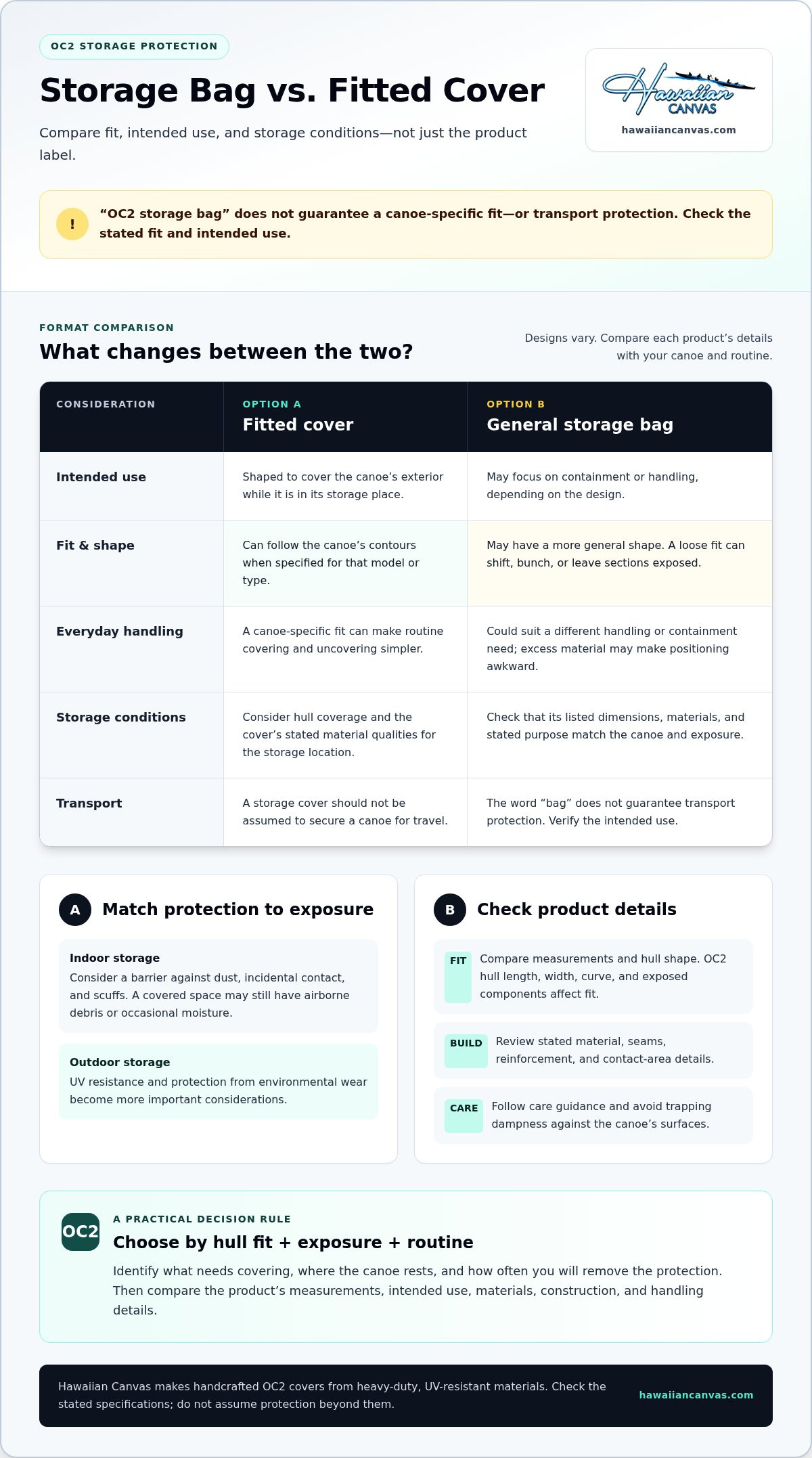
The best format depends on where your canoe stays and how often you move or access it. A fitted cover is shaped to protect the canoe’s exterior while it’s stored. A general storage bag may emphasize containment or handling instead, but the word “bag” doesn’t guarantee an OC2 will fit securely. Compare the product’s stated purpose and fit details with your routine.
| Consideration | Fitted cover | General storage bag |
|---|---|---|
| Intended use | Covering the canoe in its storage place | Containing or handling gear, depending on the design |
| Fit | Made to follow a canoe’s shape when specified for that model or type | May be more general in shape; confirm dimensions and compatibility |
| Handling | Consider how easily it goes on, comes off, and stays positioned | Consider access, storage space, and how it’s meant to be moved |
| Storage environment | Choose material and coverage suited to indoor, covered, or outdoor storage | Check whether its documented purpose matches the same conditions |
When does a fitted OC2 cover make more sense?
Choose a fitted cover when your priority is covering the canoe in its storage location and you want a shape intended for the hull rather than a generic enclosure. Its value depends on accurate compatibility and the protection details stated by the maker, not on an assumption that any fitted design blocks every hazard. Hawaiian Canvas makes handcrafted OC2 covers using heavy-duty, UV-resistant materials.
Before deciding, consider where the canoe rests and how often you’ll put the cover on and remove it. Resources from the BoatUS Foundation for Boating Safety and Clean Water provide broader boating-safety context; careful storage and handling remain important alongside any cover.
When might a general storage bag be more practical?
A bag-style option may suit a routine where containment or handling is the main concern, provided its dimensions and design work with the canoe. Consider available storage space, how frequently you need access, and whether you’ll move the canoe while it’s protected. A loose, oversized bag can shift or snag; one that’s too small may be difficult to position. Don’t assume a generic product will accommodate an OC2’s hull and outrigger components.
Neither format is universally better. Match the choice to the canoe, storage setting, and handling routine, then verify fit and intended use from the product details.
How to Check OC2 Fit and Prepare for Storage
A careful fit check starts before the cover goes on. Identify your canoe’s make and model, then use the product’s measurement instructions. Don’t estimate from a similar OC2. Hull length alone won’t show whether its profile, width, or exposed components will match the protection.
What measurements should an OC2 buyer compare?
Compare the overall length and hull profile using the measurement points specified by the maker. One product may measure from different reference points than another, so follow its directions rather than relying on a general length figure. Check how the instructions account for the canoe’s shape and any components the cover is intended to accommodate. Never assume one size fits every OC2.
How can paddlers store an OC2 with less wear?
Prepare the canoe before covering it. A clean, dry hull helps prevent loose debris from being trapped against the surface, and letting it dry reduces the chance of sealing in moisture. Position the canoe securely so it isn’t resting under unnecessary pressure or against rough contact points.
- Identify the canoe. Note its make, model, and relevant hull profile.
- Check the product dimensions. Follow the maker’s measurement points and fit instructions.
- Prepare the hull. Remove loose debris and allow the surface to dry.
- Fit the protection. Position it as directed, without forcing or stretching it into place.
- Inspect placement. Look for trapped moisture, rubbing points, shifting material, or loose fastening.
Check the fit again after the protection is in place. Material that bunches or rubs at a contact point may need repositioning; loose fastening can allow movement during storage. Periodic inspections help you notice moisture, shifting, or contact wear before it becomes a recurring problem. If the canoe is stored for an extended period, include these checks in your routine.
Understanding marine-grade canoe cover materials can help you compare protection options, but preparation and fit matter too. Hawaiian Canvas makes handcrafted OC2 covers with heavy-duty, UV-resistant materials. Explore handcrafted OC2 covers as you consider protection suited to your canoe and storage routine.
Choose Handcrafted OC2 Protection for Your Storage Routine
The right choice isn’t simply a bag or a cover. Match the protection to your canoe’s shape, where it will be stored, and how often you’ll put it on, remove it, or move the canoe. Check product details for fit, material, intended use, and handling before deciding. An OC2 storage bag that doesn’t suit those conditions may create more hassle than protection.
What makes Hawaiian Canvas relevant to OC2 owners?
Hawaiian Canvas makes handcrafted covers for OC1 and OC2 canoes. Its covers use heavy-duty, UV-resistant materials, making the OC2 cover a relevant option for paddlers considering storage protection, particularly where sun exposure is a concern. These material and construction qualities are practical points to weigh, not promises of complete weather protection or a particular service life. Storage conditions and careful handling still matter.
A purpose-made canoe cover is designed for a different job than a general container. Compare the OC2 cover information with your canoe and storage setup, and consider whether the described fit and protection align with how you’ll use it.
What should readers do before choosing?
Use a short checklist to keep the decision grounded in your actual needs:
- Fit: Identify your canoe and follow the product’s measurement instructions.
- Exposure: Consider whether it will be stored indoors, under cover, or outdoors.
- Handling: Think about how often you’ll cover, uncover, or move the canoe.
- Details: Review stated materials, construction, and intended use without assuming features that aren’t described.
Then compare those points with the OC2 cover information on the product page. If your canoe’s profile or storage routine differs from what you expected, revisit the fit and use details before settling on a format. A clear match between canoe, exposure, and everyday handling is more useful than choosing by product label alone.
For handcrafted canoe-cover protection made with heavy-duty, UV-resistant materials, explore Hawaiian Canvas OC2 cover options and compare them with your storage routine.
Choose Protection That Fits Your OC2
The right storage protection starts with the canoe itself. Check fit against your OC2’s shape and dimensions, then weigh where it’s stored and how often you’ll handle the protection. A fitted cover and a general-purpose bag can serve different routines, so compare their intended use and documented construction rather than choosing by label alone.
Before storing your canoe, remove loose debris, let the hull dry, and inspect how the protection sits. A suitable fit and regular checks help you spot rubbing, trapped moisture, or shifting material early.
Hawaiian Canvas makes handcrafted canoe and surf ski covers, with OC1 and OC2 covers among its offerings. Heavy-duty, UV-resistant materials are a practical feature to consider for storage protection, though no cover replaces careful handling and appropriate storage.
Ready to compare a purpose-made option with your needs? Explore Hawaiian Canvas OC2 covers and take the next step toward a storage setup that works for your canoe.
Frequently Asked Questions
What is an OC2 storage bag?
An OC2 storage bag is protective gear intended to cover or contain a two-person outrigger canoe while it’s stored. The term can describe different designs, so check whether a product covers the hull, encloses the canoe, or is intended for another handling purpose. Its shape and dimensions should suit the canoe’s profile and any components it’s designed to accommodate. A product label alone doesn’t confirm fit or transport use.
How do I choose the right size storage bag for an OC2?
Use the product’s measurement instructions and compare them with your canoe’s make, model, overall length, and hull profile. Pay attention to where the maker says to measure, since reference points can differ. Don’t estimate fit from a similar canoe or assume one size works across OC2 models. Check whether the product is intended to cover the parts you need protected, then inspect the fit for bunching or exposed areas when positioned.
Is an OC2 storage bag the same as an OC2 cover?
Not always. “Bag” may refer to an enclosure or a looser storage format, while “cover” often describes protection placed over the canoe. Makers may use these terms differently, so review the intended use, fit, and construction details rather than relying on the name. A fitted cover is designed to follow the canoe’s shape when specified for that craft; don’t assume it provides transport protection unless that use is stated.
Can I leave an OC2 covered outdoors?
You can store a covered OC2 outdoors if the cover is intended for the conditions and the canoe is positioned appropriately, but a cover doesn’t guarantee complete weather protection. Look for documented material qualities, such as UV resistance, and follow care instructions. Keep the hull dry before covering it, avoid unnecessary pressure or rubbing at contact points, and inspect periodically for moisture, movement, or areas left exposed.
How should I prepare an OC2 before putting it in a storage bag?
Remove loose debris and let the hull dry before covering or enclosing the canoe. Grit trapped between the material and hull can contribute to rubbing, while dampness held in storage may be undesirable. Position the OC2 securely, then place the protection according to its instructions without forcing it into place. Check for trapped moisture, bunching, rubbing points, and loose fastening, and recheck the setup during storage.
Are UV-resistant materials important for an OC2 storage bag?
UV resistance is worth considering if your canoe is stored where sunlight reaches it, since it’s a stated material quality relevant to sun exposure. Hawaiian Canvas makes handcrafted canoe and surf ski covers using heavy-duty, UV-resistant materials, including OC2 covers. Compare the material information with your storage conditions, and follow the product’s care guidance. UV resistance does not mean a cover blocks every environmental effect or removes the need for sensible storage.
Can an OC2 storage bag also protect a canoe during transport?
Only if the product is designed and specified for transport. Storage protection and transport protection are different uses, so don’t assume a bag that covers a canoe will stay secure or protect it adequately while moving. Review the stated purpose and fastening instructions, and make sure the canoe itself is secured appropriately for transport. If the product information describes storage use only, treat it as storage protection rather than travel gear.